By Frank J. Diekmann

It sounds just like one of those origin stories you hear so often around successful American companies, a credit union version of Hewlett Packard or Amazon, both of which began in a garage. Someone has an idea for a new way of doing things, skeptics look to pour cold water and drown it, but it scrapes together some capital, slowly establishes roots and then grows to the point where it’s so ubiquitous it’s hard to believe it ever didn’t exist.
Credit unions have a story like that, and while it doesn’t begin in a garage, it has often ended in too many to count.
It may seem hard to believe that a credit union owned-company that has now done more than a half-trillion-dollars in loans for more than 70-million members once had to convince CU leaders there was a market opportunity to be had. But three people who were there before it even had a name say that was exactly the case.
And not only did it have to pull off that sales pitch, it had to overcome some pretty entrenched opposition from all sides as well as some slow initial growth before it could become the presence it is today.
Back in the Day Warnings
“It,” in this case, is Origence, which began its life in 1994 as Credit Union Direct Lending (CUDL)--making that the Origence origance story. That was in the days when credit unions relations with automobile dealers—if there were any relations at all—were often strained—I attended a credit union meeting back in the day where one person stood up and called car dealers “liars, punks and thieves,” and was applauded for doing so--and CUs counseled members to come into branches and get preapproved for loans before heading to dealer for those now infamous “Let me go talk to my manager and see what we can do” negotiations with salesmen.
At the time credit unions were warning members against becoming so intoxicated by that new car smell that they allowed themselves to be steered into a bad loan. Not to mention that undercoating you didn’t need.
Origence turned 30 this year, which it celebrated at its recent Lending Tech Live event in San Diego. Begun with start-up capital of $200,000 each from The Golden 1 Credit Union in Sacramento and the California Credit Union League, it now has relationships with approximately 1,100 credit unions (in total it comprises the largest auto lender in the U.S.), and has done more than $550 billion in auto loans during its life. This year the CUSO, which now operates several other lending operations beneath the Origence umbrella, expects to do about $62 billion in loans to about 2.4 million members.
Pulp Fiction & Ace of Base
With Pulp Fiction leading the box office and Ace of Base the most popular act in what was once known as the Top 40, CU Direct Lending launched with a few employees working out of the California league’s headquarters with Tony Boutelle as its CEO.
Boutelle continues to lead the organization that has become so ubiquitous now, as he pointed out, it’s a verb in credit unions, as in “We can CUDL the loans,” or, in what today would be a great big HR violation, “Let’s CUDL.”
During Lending Tech Live Boutelle was joined by Stan Hollen, the former CEO of The Golden 1 Credit Union, and Diana Dykstra, who recently retired as president of the California and Nevada leagues, in sharing their recollections of the company’s early days.
One story shared during the meeting, by the way, was that at one point Boutelle was so frustrated that others couldn’t see the vision or the opportunity to be had in making loans at the dealership and were looking to scuttle the idea, that he pounded his hands on the table and said he would invest his own money if he could.
Here are some of what they shared:
Q: What inspired the company and the original goal?
Hollen: We were in an environment in which we were competing with captive lenders. Fortunately, we had upgraded our systems and has just implemented credit scoring. We were the first big credit union to do credit scoring. We used to have huge, massive file cabinets on wheels with all kinds of documents in them. We needed to do something.
About that time Diana came forward and some others and said we think we can find ways to do loans at the dealer. We had a board member whose brother owned Maita Auto Group and Maita Toyota became the first. They worked with us closely with some other dealers and we were able to get terminals in several dealers. We asked some Sacramento-area dealers to join us.
Dykstra: It was a little tough. (The dealers) were asking, ‘Why do we need you? It doesn’t make any sense.’ They didn’t understand they were going to tap in to the credit union system and all of the members we could bring to their dealership.
Hollen: We needed a name for it. We called it Dealer Direct Lending. It became obvious we needed to grow it to become much larger. I called (then California CU League CEO) Dave Chatfield and said maybe we could join together, which we did. The question was w hat are we going to call it? I said, let’s call it Credit Union Direct Lending. And it took off from there.
I’d like to congratulate Tony for doing a phenomenal job of taking it so much further than the original concept.
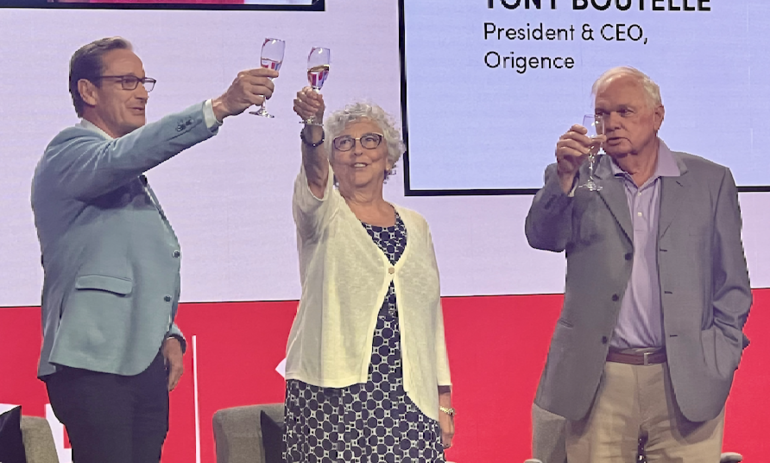
From left, Tony Boutelle, Diana Dykstra and Stan Hollen raise a toast to 30th anniversary of Origence during recent meeting in San Diego.
Q: What were some unexpected challenges?
Hollen: In the early days it was really trying to create a model that was sustainable. Today, credit unions are in every market, but Sacramento was really the first one. Diana got that going. But as you expanded it, in every single market you went to (the questions from credit unions was), ‘How many dealers you have?’ and from credit unions, “How many dealers to you have?” It was this this chicken and egg thing that was always a hard thing to figure out.
We realized that we needed a big credit union like The Golden 1 in every market to take the lead. If we could get them to do that then we could get the dealers to join. Coming up with how much to charge credit unions individually and the dealers took some time, so there were a lot of that those challenges involved.
But it really was just taking something that was already a great idea—there were already a few credit unions in Texas that were doing it--but really, it was fairly new. It just made sense.
Q: How has it impacted you personally or professionally?
Hollen. It’s nice to look back and see something you helped create that has flourished and done really well. I guess it’s a bit of a legacy.
Dykstra: I have to say It’s the best thing I was ever involved in. I would never have expected it. We sat in a little office and didn’t know where it was going.
Hollen: We got to about 200 dial-up CRTs. You can imagine how slow those were. (CU Direct Lending) filed for and received one of the only patents in the credit union movement on point of sale lending at the dealership.
Boutelle: It’s actually three patents. It’s a pretty big deal. (We had only one) programmer with the company for the first 10 years. Today we have 285.
Q: How did the dealer relationships evolve?
Boutelle: The relationship between credit unions and dealers has grown so much better. It’s such a respectful, mutually beneficial relationship.
But there were days when credit unions really just wanted to do the direct loans; they didn't want to work with dealers. But I think you can tell just from the dealers we had here on the on the stage (CUToday.info has that story here https://www.cutoday.info/site/THE-feature/Insights-Shared-on-Relationships-With-CUs) as well as the 20,000 on our platform, that credit unions have built a much better relationship.
But it was hard to convince them. We’ve got some stories from some national meetings where these credit unions were really adamant about never doing it.
But we sold stock to credit unions and now there are130 (stockholders). Fortunately, many of the big credit unions came in.
I think one of the great things the dealers benefited from is used car lending. It's so important to credit unions. It always was. There is subversion (of rate financing) by the finance companies on the new cars, but they seldom finance used cars. This is a huge benefit for them in getting vehicles off a lot.
Q: What would you do different in hindsight?
Boutelle: I would have moved faster. We really didn't know what we had, we didn’t know what how big it could be. We moved pretty slowly. It took 10 years just to get to Nevada and then it was very slow moving from there. We should have gotten to the east side of the United States a lot faster. We would have been able to get the credit unions on the platforms.
Hollen: Credit unions had to take a leap of faith. First of all, they had to understand and utilize credit scoring, and back then a lot of them were not. And they also had to believe in indirect lending and working with dealers instead of opposing them. We had several interesting national meetings that this topic came up. We used to have a debate at the national roundtable.
Q: What is going to happen over the next five years?
Boutelle: The channels are not going to go away, there are just going to be more channels for your members to get loans and to start the loan. I think we need to be in those places.
The dealers are also going to be changing. I think you're going to see much more consolidation of dealers and they're going to go with fewer lenders. So, how do we represent you if we don’t have credit unions in that drop-down box? We set up FI Connect, the finance company, to play that role and get your members back to you. And I would not count out Amazon from becoming a huge dealer. How do we partner with some of those players?
I think the credit union value proposition is well appreciated by these national players. but they can't deal with the fact that there's 1,000 different ways that could be done. How can we normalize that and make it work for all; that's going to be a big challenge, I think, going forward. But I think we can really help make that happen.
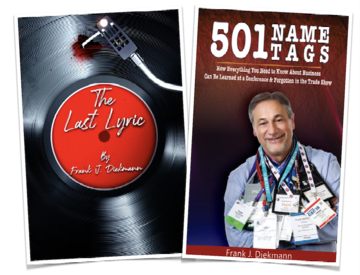
Frank J. Diekmann is Cooperator in Chief of CUToday.info and can be reached at Frank@CUToday.info. Mr. Diekmann is also author of several new book, including the brand new “The Last Lyric,” a humorous satire about a murder investigation at the Rock & Roll Hall of Fame in which every line of dialogue is either a classic pop/rock song title or lyric. Available on Amazon, Apple iBook, Barnes & Noble and Smashwords. Mr. Diekmann is also author of a non-fiction compilation of the very best & worst he has seen and heard in covering more than 500 CU meetings and conferences, “501 Name Tags: How Everything You Need to Know About Business Can Be Learned at a Conference & Forgotten in the Trade Show.” It is available on Amazon, Barnes & Noble, Apple, Lulu, and Smashwords.