

By Steven Houle

Credit unions finished 2019 with very strong performance ratios and, although there were whispers of a slowing economy, they were poised to turn in another strong year in 2020. Unfortunately, the rapid spread of COVID-19 has tragically impacted lives, social habits and economies across the globe, and consequently, credit unions.
What trends and critical issues can we anticipate in 2020 as credit unions focus on employee and member safety, delivering services and products through remote channels and navigating changing economic conditions?
The best way to answer these questions, at this time, may be to examine how credit unions performed during previous economic downturns and apply the relevant trends to today’s balance sheet.
Global Financial Recession vs. Great Lockdown Recession
The most recent recession to examine is the global financial crisis that started in late 2007 with the devaluation of the U.S. subprime mortgage market and expanded into a global banking crisis with the collapse of Lehman Brothers in September 2008.
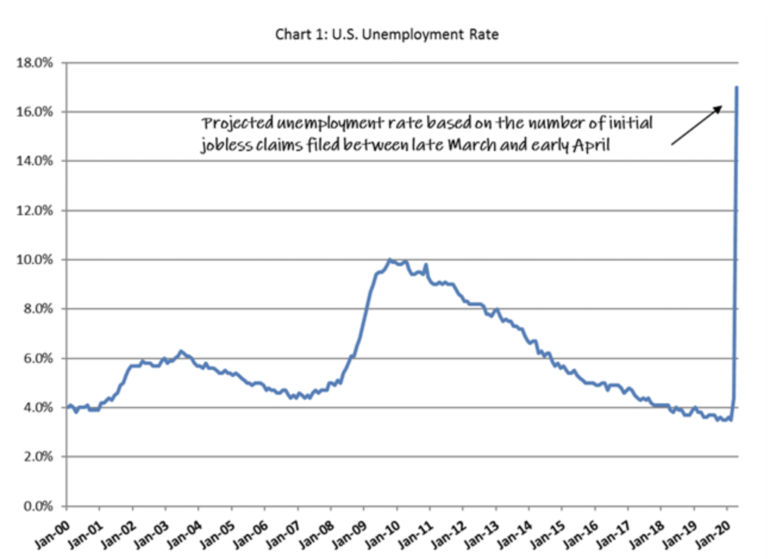
To combat the growing crisis, the Federal Open Market Committee (FOMC) lowered the Federal Funds rate from 5.25% to 0.25% over the course of 15 months, and the federal government introduced numerous economic stimulus packages. Even with government support, the U.S. unemployment rate increased from 4.7% to 10.0% from September 2007 to September 2009 and stayed above 9.0% until November 2011. Gross domestic product (GDP) slowed and was negative in 2008 and 2009.
Even though the COVID-19 pandemic – which is now being called “The Great Lockdown Recession” – is in its early stages, the global impact has been quick and unprecedented, and the impact to U.S. unemployment and GDP could be worse than during the global financial crisis. The unemployment rate has increased from 3.5% in February to 4.4% in March and could climb to 17% in April based on initial jobless claims that have been filed since the March 12 cut-off.
The impact to GDP will not be known until further economic releases become available, but the Internal Monetary Fund’s baseline projection for U.S. GDP is -5.9% in 2020, with a rebound to 4.7% in 2021.
These projections were detailed in the IMF’s April World Economic Outlook and were based on two assumptions: 1) the pandemic fades in the second half of 2020, and 2) policy actions taken around the world are effective in preventing further economic distress. Although the potential recovery in 2021 provides some comfort, the economic loss in 2020 is almost three times more severe than in the 2009 global financial crisis.
Credit Union Impact
During the 2009 recession, credit unions experienced numerous balance sheet trends that are worth exploring to see how they may impact credit unions today.
Loans and Share Growth
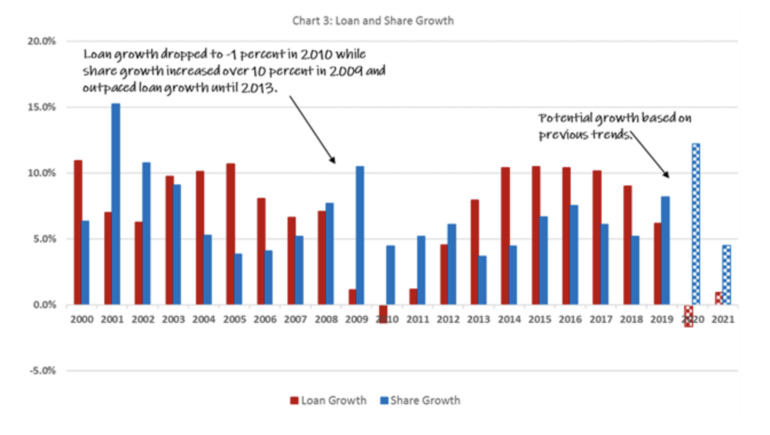
Between 2009 and 2011, credit unions experienced a significant drop in loan growth as members stopped borrowing and focused on saving. Vehicle loans declined to -1.4% and -5.5% in 2009 and 2010, while real estate loans slowed but never went negative.
In 2009, vehicle and real estate loans were 30% and 51% of the industry’s portfolio, respectively, compared to 34% and 51% at the end of 2019. By applying the trends from the 2009 recession and considering that loan growth slowed to 6% in 2019 from 10% over the previous five years, loan growth could be negative in 2020 with a slight rebound in 2021.
Credit unions will likely see weak demand for new cars as members avoid visiting dealerships in person, but vehicle refinance demand should be strong. Similarly, new home purchases will slow, but mortgage refinance demand will be strong as mortgage rates have fallen to historically low levels.
Loan Quality
Unfortunately, credit unions experienced higher charge-offs during the 2009 recession as members endured economic hardship. Charge-offs increased in each major loan category and peaked in 2009 at 1.21%. Subsequently, they declined in 2011 and 2012, before stabilizing between 50 and 60 basis points for the last six years.
Forecasting the charge-off curve is difficult this early in the recession, since many factors are in play, including portfolio allocations, collateral values and the numerous government programs that have been introduced to help consumers and businesses. That said, applying a similar curve would project charge-offs peaking in 2021 at 1.30% and normalizing by 2024
Liquidity and Cost of Funds
With members postponing spending during the 2009 recession, credit union non-term shares increased over $200 billion, or 55%, between 2008 and 2012, while term certificates declined $28 billion, or 13%. As a result, liquidity was strong and the industry’s cash and short-term investments to assets ratio increased from 14% to almost 18%.
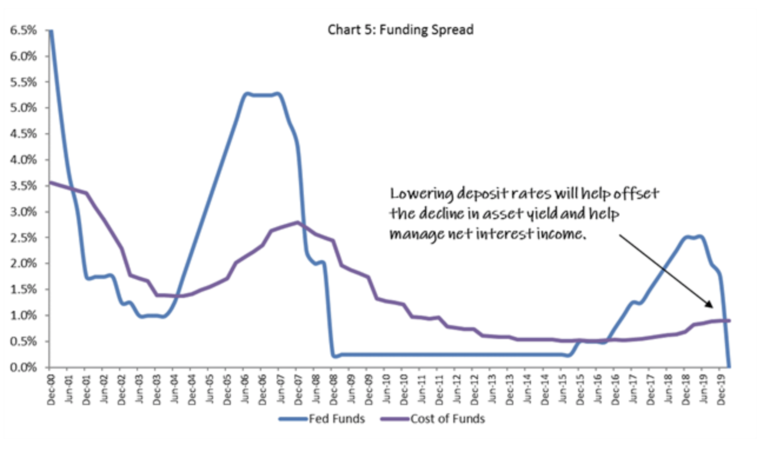
To manage growing deposits, weak loan demand and spread compression, credit unions lowered deposit rates. Cost of funds declined from 2.80% at December 2007 to approximately 0.50% at March 2016.
Lowering deposit rates will be an effective way to manage net interest margin this time around, but given the starting point of 90 basis points, the offset will not be as big as in 2009. However, it could happen quickly, as non-term shares represent 70% of credit union shares, compared to 59% in 2009.
Earnings and Net Worth
Earnings compression is expected as loan demand contracts in 2020 and loan yields fall due to historically low benchmark rates. Between 2008 and 2012, loan and investment income fell by approximately 12% and 41%, while interest expense declined by 62%.
If similar trends transpire during this recession, loan portfolio yields could fall from 4.89 to 4.20%, while investment portfolio yields could fall from 2.37 to 1.30%. To offset the declining asset yield, cost of funds could fall from 0.90 to 0.40%. Net worth ratio will face headwinds as strong deposit growth and weaker earnings are forecast ahead.
Final Thoughts
Although each credit union has a different balance sheet composition, having a robust asset/liability management process that evaluates past trends will be valuable in forecasting future scenarios and strategies.
Scenarios should include multiple factors to gain more insight into potential performance. For example, how will flat loan growth, increased investment allocations and strong deposits growth impact earnings? What threshold does your net worth ratio have to stressed levels of charge-offs?
Steven Houle is VP, Advisory Services with Catalyst Strategic Solutions.