

By Ed Cody

Now, more than ever in our recent history, we need to be fiscally resilient given the financial pressures facing credit union members during this unprecedented pandemic. I was pleased to see CUToday Editor Frank Diekmann raise awareness regarding cost reduction efforts in credit unions.
While listing cost-cutting ideas is useful, my 40 years of experience in business process improvement efforts in the national defense community and at PenFedhas shown that organizations that employ a holistic approach and make efficient and effective operations part of their culture have more enduring and successful outcomes. This starts with the credit union’s strategy and the tone at the top.
Making Trade-offs
I learned that to be effective, cost-cutting is not as simple as selecting items that others have tried or solely about reducing expenses. Rather it is about trade-offs and making smart investments aligned to your strategy, while seeking ways to optimize your expense structure that results in optimized earnings. Sometimes you have to spend money to save money and make money.
As a financial institution, there are only so many things you can do to drive earnings. The operating expense ratio is one of five levers you can push and pull to drive net income.
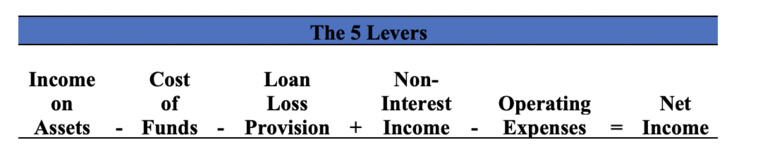
If your goal is producing a positive net income, then reviewing your operating expenses with a view toward finding savings that could be returned to the members or invested in operations would seem appropriate. However, if it comes at the cost of reduced net income due to lower income on assets or lower non-interest income, perhaps it is time to re-evaluate those operating expenses and how they are affecting your bottom line.
Employing Discipline
Expense control is a journey, not an event – and it takes discipline. Decades ago, PenFed’s operating expense ratio was 3.5%, and we knew that we had to focus on reducing costs to enable our members to do better financially. Theboard and CEO made cost-consciousness part of the organization’s overarching approach. We employed a team approach that included personnel from business units, finance, IT, operations and so on.
While top-down driven, an enterprise approach selects the best and brightest ideas from all levels within the credit union. No expense item is too small for consideration. Given the ever-changing economy, certain expenses that you’ve already optimized may have more savings to contribute. That is why I believe this should be a CFO-led multi-year initiative, not a one-time exercise.
The budget-driven process we utilized also employed the best of proven disciplines such as Total Quality Management, Business Process Reengineering, and a Balanced Scorecard to keep our focus on effective operations at the optimum level of expenses. It took years of cost discipline and a keen focus on the targeted outcome to reduce our expense ratio. This resulted in better pricing power and investments in people, technology, and facilities to serve our members. It was a philosophy of “buy and do only what is necessary, and obtain the highest return on investments.”
Aligning Strategy
If your strategy is not producing the desired financial results, how should the lever of Operating Expenses be assessed, particularly in a post-COVID world impacted by low interest rates, compressed margins, and increased loan losses? Clearly, there is no “one-size-fits-all” approach and it is important to recognize the idiosyncratic position within each credit union.
I believe that COVID-19 has forever changed the business landscape. Telework, the need for anywhere/anytime access to credit union systems and services, and facility requirements will no doubt be topics of our internal assessments. Expense opportunities should be evaluated against a clear strategy. As a board member, my questions center around what must we do to support the strategy and when do we need to make that investment, versus what are more discretionary expenses that can be reduced, delayed or eliminated altogether.
Questions to Consider
Operating Model
- Given our experience during the pandemic, how many members will continue to enter a branch versus using telephone or online services? How many branches will we need going forward?
- Are essential branches at an appropriate size, or should they be resized?
- Can we defer adding new facilities or making major facility improvements in the short run?
Variable-ize Expenses and Contracts
- Are there fixed costs that would be better to outsource and convert to a variable expenses?
- Are there services or functions we should consider for outsourcing?
- When was the last time we negotiated our major contracts with vendors or put contracts out to bid?
- Have we contacted peers to compare pricing?
Simplify
- Are there operational activities that we should stop doing or that can be automated?
- Are there functions that can be consolidated into one location or other opportunities to consolidate/realign functions?
- Do we have an appropriate span of control?
- Are we investing in innovative technology, applications software, and operational hardware?
- Have teleconferences and on-line resources changed our approach to training and travel?
Tough Questions
The process can also lead to some tough questions. In this environment, scale matters. At the end of an honest assessment, some boards and CEOs may face the concern of whether they can continue to grow in this new reality or consider finding a merger partner.
The journey never ends; it takes a new turn with each budget cycle. We are in a sea of churning whitewater. But if your volunteers, management, employees, and partners are aligned on a common goal supported and embraced at all levels, you will be able to achieve a level of financial resiliency that will sail you to an efficient, safe and sound future.
Ed Cody chairman of the Board of PenFed Credit Union, and a former chief financial executive at the Defense Information Systems Agency.