

By Frank J. Diekmann

Here’s what you missed if you weren’t at last week’s NACUSO Annual Conference in Las Vegas, ranging from the new big concern to the big idea to the big expense to a big surprise when you volunteer someone to go do something in your place (plus more).
- A year ago at NACUSO’s annual conference in Orlando, there was considerable discussion, debate and even worry over what NCUA’s proposed risk-based capital rules would mean, especially around the risk weightings for CUSOs. At this year’s meeting in Las Vegas, an attorney for NACUSO remarked, “Nobody was really happy about it, but we were able to rein it in a bit.” As a result there was almost no discussion of the issue.
- Pushing risk-based capital off the stage and stepping up to play the role of #1 Worry for CUSOs in 2016 are worries over NCUA essentially examining CUSOs. “There have been lots of concerns expressed that examiners don’t really have a lot of insights into CUSOs, much like 10 years ago they really didn’t understand member business loans,” said one person. Another person shared that they had recently heard of credit unions talking about selling their insurance CUSOs due to all the due-diligence demands around those businesses.
- One credit union at the NACUSO meeting said it was so concerned about new laws around collections practices that it removed every office phone and replaced them with phones that lacked the capacity to auto-dial anyone.
- Do you know where you stand against the member business loan cap? Maybe not, according to one attorney at NACUSO. “What is really going to affect a lot of portfolios is that the participations you buy are not going to count against your cap, even though you do have to comply with all the rules. And that is grandfathered, so as of now your MBL cap may be different than what you think it is.”
Six Intriguing Ideas, But Something Missing
- There were six very intriguing business concepts pitched as part of NACUSO’s Next Big Idea competition, which was won by RateReset.
Coverage of the other competitors can be found here. But it was hard not to notice that all the teams pitching their ideas were made up of men, as were three of the four panelists who interviewed each team. Only panelist Sarah Canepa Bang of CO-OP Financial Services kept the whole thing from resembling the College of Cardinals.
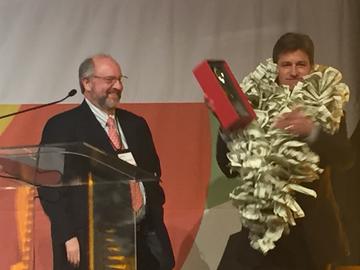
Keith Kelly of RateReset accepting trophy and (perhaps reluctantly) necklace of cash for winning Big Idea competition.
About The 'A' Word
- Paul Ablack, CEO of OnApproach, said his favorite FI is now Fidor Bank in Munich, Germany, which he said “reinvented itself and became a credit union. It has 300,000 members. It says ‘We have interest rates set by you.’ Think that is the future of banking? It’s a model built on collaboration. That’s what credit unions are built on.”
- Speaking of Mr. Ablack, he recommends everyone read “Competing on Analytics,” saying “analytic competitors significantly outperform their peers.”
- And speaking of analytics, which has become the buzzword on steroids at just about every credit union conference, including the NACUSO meeting, Ablack said individual CUs better bring some humility to the business of analytics. “I will tell you that the resources needed to build a data warehouse are outside the reach of most credit unions. If you want to build it, you have to budget $2 million over three years for a base solution.” The only solution, said Ablack, is for credit unions to collaborate on analytics. His company, OnApproach, is in the data analytics biz and is a CUSO.
- More on the A word. A representative of FICO, commonly thought of as the purveyor of the boring old credit score, said, “What we’re seeing in the credit union space is significantly increased interest in customized models and analytics. We’re also seeing a lot in deposit modeling and optimization, which four or five years ago didn’t exist in our space.
The Slow Road To Being Fast
- Tom Davis of CSCU, who is part of the Faster Payments taskforce, observed, “It is the slowest moving project I’ve ever been part of in my life.”
- Payments was, not surprisingly, a common theme at the NACUSO meeting. While credit unions and CUSOs have justifiable concerns over being “disrupted” out of the space, there seems to be growing consensus that those start-up fintechs are eventually going to be swept under the regulated umbrella. “How long can they dodge regulatory supervision? (Fintechs) have the better experience, but at some point they may have to come to us. Compliance flies in the face of being nimble. We are very good at being trusted at holding financial value.”
- Asked when the market will see plastic transactions plateau and decline in favor of mobile payments, Davis responded, “Not in the near future; 2019 at the earliest. Everything is in place for digital payments where you could take your wallet and throw away the plastic,” acknowledged Davis. “It’s just a matter of when the cardholder will be incentivized to do it.”
- Finally, Davis observed that while many Millennials have no interest in paying for cable TV, there is something that still keeps many of us from joining them. “We won’t cut the cable because of fear of missing that football game. So we pay $200 a month for it.”
- Paul Fiore of CU Wallet was among those at NACUSO who is seeking to establish the credit union as a larger part of the buying process. Fiore wants to see credit unions come together on a single vision collectively and “rally together and not allow third-party intermediaries to play the role for us. We have a unique industry. The vision is to create a container approach to keep credit unions in a position to extract value and keep gatekeepers from taking that away from you.”
Creative Graffiti
Conference speakers talking “innovation,” “creativity,” and “disruption” are about as common as people moaning, “Oh, man, I was going to take (insert team name here) in my March Madness bracket.” Indeed, the irony is it’s often difficult to differentiate among all the speakers talking about differentiation.
That’s not the case with Eric Wahl, a former business exec who lost it all in the dot.com bust and who is now a graffiti artist and “speed painter,” whose presentation on innovation and change is built around the speed-painting of various pieces of art.
I already know what you’re thinking, as did Wahl: “Who better to understand Janet Yellen’s lack of clarity than a graffiti artist?” asked Wahl.
You can find complete coverage of Wahl’s presentation here.
But among some of the points you won’t find in that story:
* When Wahl asked an audience afraid they were going to be called on stage, “Who can draw?” no hands were raised.

These 2 Eric Wahl paintings were auctioned for more than $1,000 each at NACUSO meeting.
“So a little less than half of you,” he joked. When he picked one person out of the audience to come on stage, he gave that person the option of sending someone else in his place, and that person immediately identified a co-worker. Too bad. Wahl gave that person one of his paintings, which are valued at more than $1,000. Later in the conference, two of the paintings Wahl created during his presentation were each auctioned for more than $1,000.
* Wahl reported that the smell of Crayola crayons alone is enough to reduce blood pressure in adults by up to 10 points. “So if you’ve had any frustration with social media as a business tool for gaining business traction and it feels like a never-ending high school reunion, grab your crayons,” he observed.
* The artist acknowledged that Southwest Airlines has become the “most overused business cliché in business services delivery.” But there’s a reason, he said. “This happened to me, and even though they are the most overused business cliché, they continue to outperform their competitors, even as their competitors have access to their playbook. I was coming into Vegas and our flight had a hard landing. The pilot came on and said, ‘Ladies and gentlemen, Southwest will not be charging you extra for that second landing.’ Southwest knows they can hire people for the basic blocking and tackling. But they also know it’s far more difficult to train those people to have the attitude and flexibility to deal with the onslaught of challenges and changes that will take place and which don’t yet even exist.”
The People Helping People (Who Aren't Helping People) Business

John Spence at NACUSO.
- Credit unions pride themselves on their “people,” noted management consultant and author John Spence. They are friendly and kind, basically “people helping people” kinds of people. And a lot of them need to go, he said. “What I see is a lot of in people in leadership and management, especially in a space as member focused as credit unions, who are really nice and sweet—and they are incompetent”
- I think its safe to assume they weren’t expecting any “new business.” On the conference agenda NACUSO’s annual business meeting was scheduled from 5:00 to 5:10.
Frank J. Diekmann is Cooperator in Chief of CUToday.info and can be reached at Frank@CUToday.info and followed at @FrankCUToday.