

By Theran Colwell

NCUA is determining its next step on alternative capital after receiving more than 800 comments on its Advanced Notice on Proposed Rulemaking (ANPR), an important step in modernizing capital regulations to provide credit unions robust and diverse ways to manage their capital. A notice for proposed rulemaking could be next, so it is pertinent to become familiar with alternative capital terminology, review the benefits and model the potential impacts.
Defined Terminology
“Alternative,” “secondary” and “supplemental” capital have been used synonymously to describe capital from debt or borrowings. In NCUA’s Alternative Capital Board Briefing and ANPR, these terms were uniquely defined.
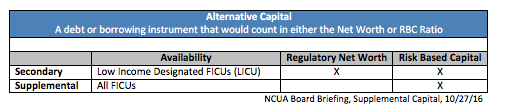
Note that any low income-designated credit union (LICU), about 40% of all credit unions, can issue secondary capital today. The ANPR sought feedback on the current regulation and considers authorizing credit unions to issue supplemental capital instruments that would only count toward risk-based net worth requirements.
Potential Benefits of Alternative Capital
Providing credit unions with robust and diverse ways to manage their capital, while adhering to cooperative principles, would bring myriad benefits:
- Provide better ability to manage growth
- Deliver a market-driven risk assessment
- Create additional value and improved efficiencies
- Support the formation of de novo institutions
- Help consumers through increased lending, products and services
- Promote investment and innovation
- Reduce systemic risks within the system (assuming capital comes from outside the system)
Model Alternative Capital Scenarios
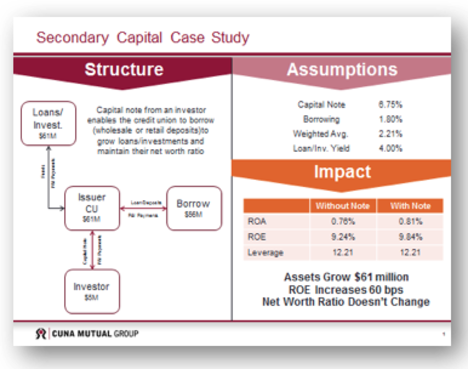
CUNA Mutual Group’s internal analysis shows most LICUs, under reasonable assumptions, would find secondary capital accretive. For example, a $1-billion credit union leveraging $5 million in capital could grow its assets by more than $61 million, increasing ROE by 60 basis points while maintaining its net worth ratio. However, supplemental capital would have a different impact.
For issuing supplemental capital, consider potential effects the capital raise would have on net worth and RBC ratios. Under proposed guidelines, supplemental capital would not count toward the net worth ratio and would actually lower the ratio for any credit union that is not also a LICU. Consider a $500-million credit union with a 10% net worth ratio that issues $10 million of alternative capital. If issued as secondary capital, its net worth ratio would rise to 11.76%, but if issued as supplemental capital, its net worth ratio would fall to 9.80%.
In both cases, the credit union added a layer of capital to protect members and the Share Insurance Fund from losses. In the latter case, its net worth ratio would not reflect its improved capital position.
There is a growing interest and awareness of alternative capital benefits, driven by the growing number of LICUs and upcoming RBC requirements for complex credit unions. We have a great opportunity in front of us to help shape and modernize the future capital regulations for credit unions. Be ready to share your perspective with NCUA.
Theran Colwell is vice president of lending loan growth for CUNA Mutual Group. Contact him at Theran.Colwell@cunamutual.com, or 608.665.8541.