

By Frank J. Diekmann
In a first, NCUA will video “live-stream” its board meeting this week on Thursday.
If you’ve never had the pleasure of attending a real, live NCUA board meeting with the electrifying entertainment that comes with an “I second the motion,” the merriment inherent in a PowerPoint presentation on the NCUSIF’s reserve ratio, or the Katy-Perry-Super-Bowl-Dancing-Sharks-like excitement of watching one of the board members’ assistants whisper into their ears, well… Don’t let me ruin it for you. But be prepared to learn why “live-stream” can be one misleading description.

Still, the agency is to be congratulated for making its meetings available to all stakeholders in credit unions and for being more transparent. Just make sure you remember how to flip over to C-Span should you need more riveting content.
* UPDATE Dept.: I wrote the following four paragraphs earlier this week: "Speaking of NCUA, it has taken some significant flack from credit unions, their trade associations and even one of its current board members for a budget that has ballooned by 50% since 2008. The trades keep using the word “transparency” in seeking reasons for the budget increases, but what they’re really seeking is “frugality.”
So it will be interesting to see how much longer the agency will be able to sustain the argument that it needs more and more funding each year.
The FDIC recently announced a 3% decrease in its 2015 budget to $2.32 billion, saying it had eliminated 325 positions due to the improving health of the institutions it oversees.
NCUA has seen a similar decline in the number of problem institutions among credit unions , and the arguments are only going to get stronger that NCUA should be following the bank regulator’s lead. For 2016, a budget reduction of almost any size would send a common sense signal to the credit unions that are financing the agency that just as credit unions are charged with being good steward’s of their members’ money, so, too, is the federal agency when it comes to the same.
But NCUA has offered this response and analysis: The agency said that since 2007 its total budget has increased much less than FDIC's budget. Moreover, NCUA said the figures I quoted (which came from the FDIC) "selectively cite reductions in FDIC's receivership budget" and "don’t reflect the true trends in FDIC’s budget, for two reasons:
* FDIC doesn't count FDIC’s Operations Budget (which increased in 2015).
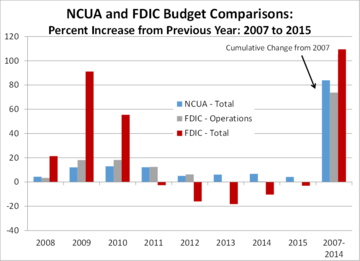
* FDIC doesn't factor in the enormous increases in FDIC’s receivership budget since 2007.
The agency sent along the chart, at right, to support its statement.
"For 2015, FDIC total budget declined by 3%, but operations budget was up .13%," NCUA said.
So there you go. I thank NCUA for its input, and welcome that from readers, as well.
In Other News...
* Writing on Forbes.com, entrepreneur David Hassell recently shared learned in starting and running companies, a number of which are relevant to credit unions.
A big one, said Hassell, is the often ballyhooed “culture.” According to Hassell, a common culprit in companies with so-called “cultural issues” is that “employees often have no idea what’s going on in other departments. Marketing, sales, and customer support don’t communicate, which means these teams might as well be operating as entirely different companies. When crucial information isn’t flowing between departments, these silos crush productivity and ultimately stifle growth.”
As credit unions grow (especially through mergers), Hassell’s observation is especially worth noting. He said what has worked for him in rectifying an office of silos surrounded by high walls is this:
* Institute a transparent workplace, with a special emphasis on management teams sharing information across the enterprise. That includes member feedback—both positive and negative, along with financials. A final note: don’t overwhelm employees.
* Get Rid of “Us vs. Them.” Building a culture is about more than just sharing information with different departments, it’s about making sure there are relationships between those departments, too, according to Hassell.
* Make Your Objectives and Key Results (OKRs) Public. Hassell advised that objectives and OKRs always be framed “within larger company goals to show people how their efforts support big-picture company objectives.” This is especially critical to many credit unions where—although few in management either care to admit it or are oblivious to it—many employees don’t actually understand how the whole operation works.
* Ask Specific Questions. “Your employees have tremendous insight into the inner workings of your company, and the best way to tap into this intelligence is by asking the right questions,” he said. “More importantly, it’s wise to maintain regular face-to-face interactions. During these one-on-one meetings, you should ask pointed questions in a way that demonstrates genuine concern and understanding about employees’ roles. Instead of asking, ‘How are things going?,’ try questions along the lines of, ‘Hey, I noticed that X is happening. Do you need support?’ ”
Risk, & Risky Weather
* Finally, two reminders from CUToday.info. This week we have launched a multi-part series that examines all aspects of NCUA’s risk-based capital proposal. We welcome your input and feedback. The first in the series can be found here.
Second, if you’re reading this while snowed in somewhere wondering why you didn’t move south when you had the chance, we welcome your photos. Is snow piled up against your windows, choking the drive through, or are you tunneling to the door? Send your pics to me at Frank@CUToday.info and we’ll share them with the CU community. Or a rescue team if need be.
Frank J. Diekmann is Cooperator in Chief of CUToday.info and can be reached at Frank@CUToday.info.