

By Frank J. Diekmann

Welcome to the disruption. But is it the one credit unions think it is––or perhaps something much more troubling?
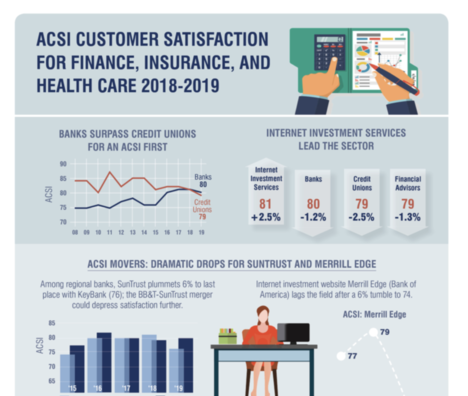
For years now everyone in credit unions has had their earholes stuffed with alliterative exhortations around “digital disruption.” It’s coming, coming, coming, CUs were cautioned. Forget that and get with it, it’s here! here! here! CU leaders have been warned. And then came the news CUToday.info was first to report out of the University of Michigan’s American Customer Satisfaction Index—for the first time in the survey’s history, credit unions finished behind banks in a rating on consumer service.
Go re-read that last sentence—because it seems the CU community has been giving it the old “nothing to see here, move along, move along” treatment. Behind banks on service. The same banks that are the butt of comedians’ jokes anytime they need a go-to punchline about bad service. The same banks one other group goes to the well for even more often than comedians when they need an applause line or want to pat themselves on the back—credit unions.
Hey, credit unions—it’s way past time to stop the patting.
In the American Customer Satisfaction Index ratings, satisfaction with all types of financial institutions declined, with bank scores were down 1.2% to an ACSI score of 80, while credit unions were down even more at 2.5% to 79.
Where is the Leadership?
Obviously, the response from the CU trade groups was immediate and forceful. Time for some self-reflection and recommitment to core values, the trades stated. We’re putting on the backburner our fancy national media marketing plans and instead putting the bucks into in less-sexy but clearly needed and more pragmatic member service training and improved electronic channels. We will absolutely get this turned around, the groups announced in a joint statement with confident determination.
Just kidding, and I’m sorry to say it, because it’s nothing to kid about. The actual response from CU community and its trade groups? The kind of silence that would have crickets asking, “Hey, is it just us or is it pretty quiet around here?” The responses from CUs and the trades has been as if the ACSI results were never released at all. And that’s kinda funny, since in prior years when credit unions finished ahead of banks in this same survey there was the kind of cocky crowing among CUs that, as they say, can come back to haunt.
Where is the leadership, credit unions?
The Haunting
So, why the haunting? Why are banks beating credit unions on service? One early theory has been that the “digital disruption” we’ve heard so much about has fully arrived and is fully disrupting. But those dire forecasts often involved predictions it would be fintechs doing the disrupting with their easy-to-navigate apps, simple messages and clean graphics, especially appealing to Millennials and younger generations. Big banks—which were supposed to be the institutions ultimately at risk because, after all, they’re cold and monolithic–heard those same warnings and poured billions into developing and improving their own digital offerings (while buying fintechs along the way).
Besides, members just love and are loyal to their credit unions, so they’ll never really be disrupted, right?
I’ll offer a couple of couple of other theories. You’ve seen all the numbers CUToday.info has reported on the millions of new people who have been added to the membership rolls in recent years. Many of those have come via the indirect channel (which is one reason membership growth is down this year), and credit unions have struggled to build any kind of meaningful ownership connection with those members—if they tried at all. So, when those consumers are contacted in a survey, how many are going to express a whole lotta love for ye olde financial co-ops? How many even know they're members? (Some CUNA Mutual research found 25% have no idea.)
The Little Things Add Up
And here’s another note that deserves more attention that it gets. During the same week the ACSI findings were being released, CUToday.info ran yet another news item on a merger you probably paid little attention to unless it was your credit union. Two more small CUs are disappearing, in this case the $7.6-million Fayetteville Postal Credit Union, which is carrying its mailbag over to the $358-million Piedmont Advantage Credit Union, and the $10-million Ocean Spray Employees FCU, which is taking its cranberries over to the $1-billion Merrimack Valley CU.
This isn’t to imply there is something wrong with Piedmont Advantage or Merrimack Valley or any of the other larger CUs that have been swallowing smaller CUs like, well, cranberries. Whether it’s the back-breaking regulatory burden, the lack of any succession plan (due to lazy boards or just because the job just doesn’t appeal to many younger people), or the “expanded products and services” that are required by the FCU Act to be mentioned in every CU press release, I get the reasons for the merger trend.
But that’s the inside-out view, which is not the view of members or consumers. From the outside in, you simply feel a closer familial bond to a place that has your employer’s name in it. Or the name of your hometown. Or the place your parents took you as a kid.
Every merger is a micro-disruption, and after a while all the micros become a macro.
The Credit Union Was Sold?

I’ve never forgotten an observation shared with me years ago by researcher Neil Goldman that the “number-one response of members in a merger is their credit union has been sold.” And even if they understand what being a member means and that their CU has not been sold, they join with everyone else in what feels like a bond broken.
Which reminds of another insightful observation I heard shared even longer ago by the acclaimed Dr. Clayton Christensen, author of many books, including the seminal “The Innovators Dilemma.” In his research and examination into how so many once dominant companies and market-leading brands came to be knocked off what were thought to be unassailable perches, conventional wisdom held they simply hadn’t seen change coming. But the conventional wisdom was wrong. As Christensen demonstrated, they saw the change coming as plain as everyone else––they just didn’t believe it applied to them.
Credit unions, it applies to you. Whether it’s digital or analog or, most likely, what I’ll call a digilog combination, the new consumer satisfaction ratings show a disruption is occurring.
Looking in All the Wrong Places
Disruption always occurs when you’re looking for love in all the wrong places; when you’re mesmerized by and opening your eyes to some shinier new thing.
In recent years credit unions have been looking at slapping their names on everything from high school football field scoreboards to NBA arenas and city convention centers. It makes you wonder if the day won’t come when a long-faded credit union's name is being painted over with the shiny name of a new sponsor and one of the painters absently asks, “What’s a credit union?” and another worker—the kind who in the long ago past would have belonged to a CU with “Painters” in its name–answers, “I dunno. Somebody said they got disrupted or something.”
Frank J. Diekmann is cooperator in chief at CUToday.info and can be reached at Frank@CUToday.infoor @FrankCUToday.