

By Michael Brown

LendEDU recently surveyed 1,000 adult Americans to better understand how the average consumer budgets his or her monthly income. This data was further broken down by the three generations that currently wield the most spending power in the U.S. economy: Baby Boomers, Generation X, and Millennials.
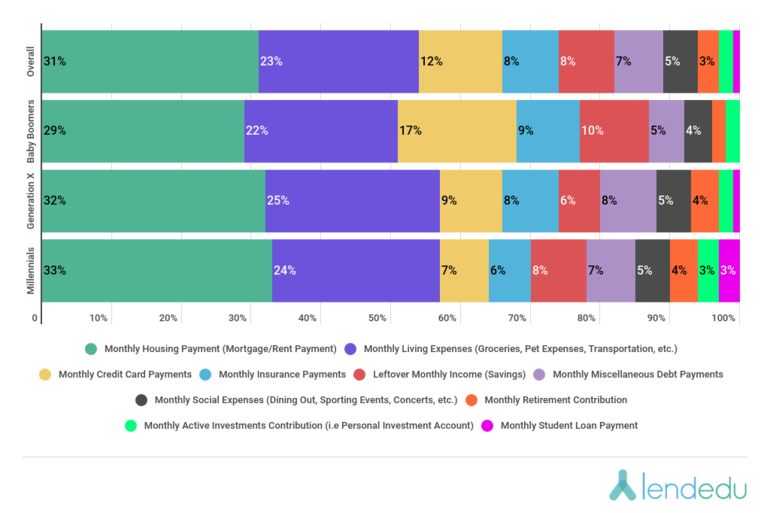
There were a few trends that transcended generational divides, with monthly housing payments, either for rent or for a mortgage, the biggest expense for all groups.
Baby Boomers between the ages of 55 and 73 were contributing 29% of their monthly income towards housing payments, which indicates that many in this generation are still struggling to pay off costly mortgages from decades ago.
Comparatively, 32% of the average Generation Xer’s monthly income was being utilized for monthly housing payments, while the percentage ticked up to 33% for millennials.
Both the current high cost of housing in the U.S. and a young Millennial’s inability to likely make a large down payment upon closing on a house could explain why this generation is forking over the most for housing.
It is generally recommended that a consumer commit only 28% of their income toward housing costs, and while each generation was quite close, none succeeded in adhering to this financial rule of thumb.
It’s Not the Avocado Toast
Another similarity in monthly spending habits across all three generations was that each group was spending about the same each month on social expenses, like going out to dinner or to a concert. While baby boomers were spending 4% of their monthly income on this, both Generation Xers and millennials were utilizing 5% of their income.
This should dispel the common media narrative that the Millennial generation is spending too much on avocado toast and not enough on property. It turns out the budget priorities of millennials are really no different than those for Generation X and the Baby Boomers.
With that being said, there were still a few trends specific to each generation that really stood out above the rest.
Booming Card Debt
The biggest discrepancy in the data came in regard to Baby Boomers and the generation’s massive commitment to monthly credit card debt payments.
On average, this generation was using 17% of its monthly income for payments toward credit card debt. This is more than double what Millennials were paying each month for their credit card activity (7% of monthly income) and nearly double what Generation Xers were forking over for credit card debt (9% of monthly income).
Despite Baby Boomers being the oldest generation analyzed in this study, it was quite surprising to see how wide the margin was between their credit card debt commitment and the commitments from the other two generations.
Baby Boomers have certainly had more time to accumulate credit card debt over the years. Additionally, as more Boomers either retire or earn less money as they struggle to remain competitive in the working world, they may be relying more heavily on financing purchases with their credit cards, not their dollars.
Saving the Least, Paying the Most
Generation X, sandwiched between Baby Boomers and millennials, was saving 6% of their monthly income, the lowest of all generations analyzed in the study.
Comparatively, Baby Boomers were saving 10% of their monthly income, while Millennials were saving 8% of their income each month.
Why might this be happening? Looking at the data from the report, it very well could be from monthly financial commitments to miscellaneous debt payments. Members of Generation X were utilizing 8% of their monthly income for miscellaneous debt, while Boomers were using 5% and Millennials were committing 7%.
Miscellaneous debt could have included things like medical, auto loan, personal loan, or tax debt.
This was interesting to see and it is tough to pinpoint an exact reason as to why Generation Xers are paying the most each month for miscellaneous debt, but that debt commitment is certainly playing a role in the limited month-to-month cash savings from this generation.
Surprise, Surprise
Not a big surprise, but the proportion of monthly income going towards student loan debt is highest for Millennials.
Currently sitting at $1.6 trillion, outstanding student loan debt in the U.S. is the highest in this country’s history and the second largest form of consumer debt behind only mortgage debt.
The average student loan borrower owes $28,565 in student loan debt upon graduation. And, as long as colleges and universities continue increasing tuition prices to record levels, this problem only figures to get worse.
While baby boomers did not have to deal with such outrageous higher education costs and Generation Xers may have just barely caught the headwinds, millennials have faced the brunt of this higher education crisis.
The data from the report backs this up. Baby Boomers monthly pledge to student loan debt doesn’t exist, while the average member of Generation X is utilizing 1% of their monthly income for student loan debt.
Meanwhile, 3% of the average Millennial’s monthly income is going towards student loan debt payments.
Michael Brown is a research analyst with LendEDU.