

By Radi Hindawi

By leveraging more than 80,000+ data points from social signals, online reviews and market pulse surveys, we have developed a new report that provides a perspective on today’s consumer behavior to help identify the make-or-break consumer demands that will influence your market share growth and member loyalty initiatives.
It is also intended to help you understand who you’re selling to on a deeper level while avoiding potential experience pitfalls.
The report identified three trends:
- Consumers want more than basic digital experiences
- Consumers expect you to support their financial freedom
- Yesterday’s experience assumptions won’t drive success
The Trends
Let’s look at each of the three trends.
Trend #1: Consumers Want More Than the Basics
Compared to other industries, however, adoption of digital strategies was slow in financial services—up until the COVID-19 pandemic, that is. Suddenly, in-branch interactions were no longer an option, and consumers were 199% reliant on the digital options available, making the digital transformation infinitely more urgent.
Now that we are out of the pandemic and consumers once again have the choice between in-person and digital experiences, we are seeing that while some are going back to their old habits, emerging financial services consumers are exclusively interested in digital, self-serve experiences.
The research found that one-third of younger consumers (Millennials and Gen Z) are NOT likely to visit a bank and/or credit union location in person. They want to be able to do things themselves while still having the ability to call in and ask questions at their discretion.
A few examples of digital experiences younger consumers want to have on-demand are:
- Online education resources where they can expand their financial knowledge on their own time
- Real-time investment tips and awareness—they don’t want to hear about an opportunity months or even weeks down the line, they want to be notified as soon as possible
- Personalized suggestions that are tailored to where they are in their financial journey, perhaps through an online portal or virtual advisor meeting
Prioritizing Cybersecurity & Other Expectations
It’s clear that to attract new consumers, financial institutions need to broaden their digital and self-serve capabilities. But alongside that digital acceleration, financial services brands need to also focus on expanding their cybersecurity capabilities.
This was a clear demand across the data, as shown in the chart.
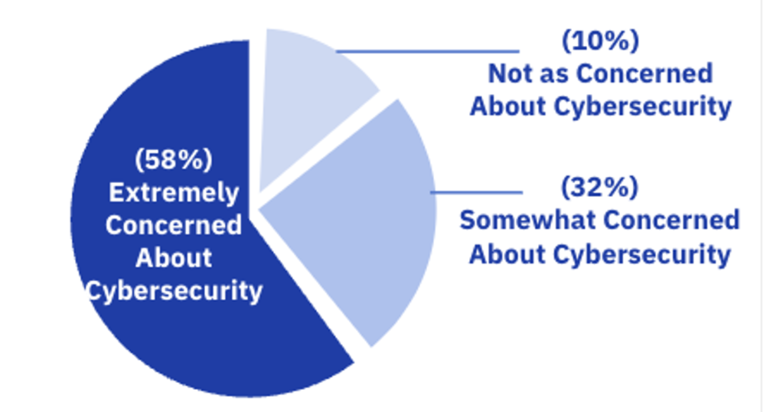
Digging deeper, in third place came digital personalization, with consumers specifically mentioning that they wanted new ways to interact with knowledgeable staff digitally.
But just as interesting as what consumers did expect from financial services brands was what they were not interested in:
- One in four Gen Z and younger Millennials are not interested in pensions & retirement saving plans
- Gen Z and Millennial consumers were 10% less likely (compared to the beginning of 2022) to invest in cryptocurrencies due to recent declines
Trend #2: Consumers Expect Support For Financial Freedom
Consumers see credit unions as a part of their lives—and that makes sense, because finances are intensely personal. Because you have access to their finances, consumers feel like you know them and their needs.
There was also a sentiment that consumers see you as a partner, and they feel that you should be helping them along their journey to financial freedom. But how can you accomplish that?
Ideally, you should be tailoring your organization's initiatives and solutions around the pivotal moments of your stakeholders’ personal lives. But how do you pinpoint the moments that matter most in your customer’s financial journey, then design experiences to support them?
One way is to create a Touchpoint Impact Map based on your member data, a visual representation of where each touchpoint in the customer experience fits between your most loyal members, and those who disengage with your brand.
Moments That Will Matter
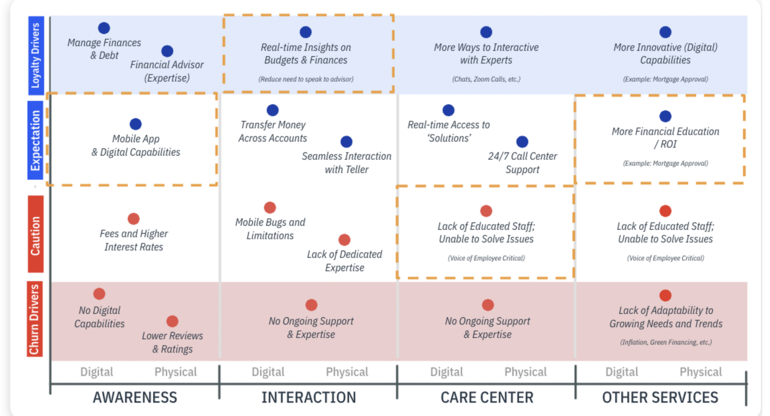
In the above map, you can see that we split the journey into four specific stages of the buyer cycle: awareness, interaction, care center, and other services (in a brand-level Touchpoint Impact Map, you can get more specific with your stages to include onboarding, arrival to a branch, calling into a call center, sitting down with an advisor, and more). We also specified digital versus physical journeys.
Driving Churn
Across these stages, you can see what is driving loyalty—and what is driving churn:
- Digital experiences are the gatekeeper to customer acquisition. Consumers simply expect them. And without them, you won’t even be in consideration for their business
- In their ongoing interactions with your brand, consumers want to have ongoing insights into their finances, whether that be how their spending habits have changed in the past month, how they can plan to pay off debt, or how to create a savings plan.
- When members call in for help, they need to be able to speak to a knowledgeable staff member. If the agent they speak to is unable to help them solve their problem, they might start to shop around for another financial partner.
- Finally, when it comes to new experiences financial services consumers want to be introduced to, financial education tools will rule the day in 2023. It’s time to start building out a self-serve knowledge center, hosting expert-led webinars and workshops, and generally building more opportunities for your members to learn how to be financially free—with you guiding the way, of course.
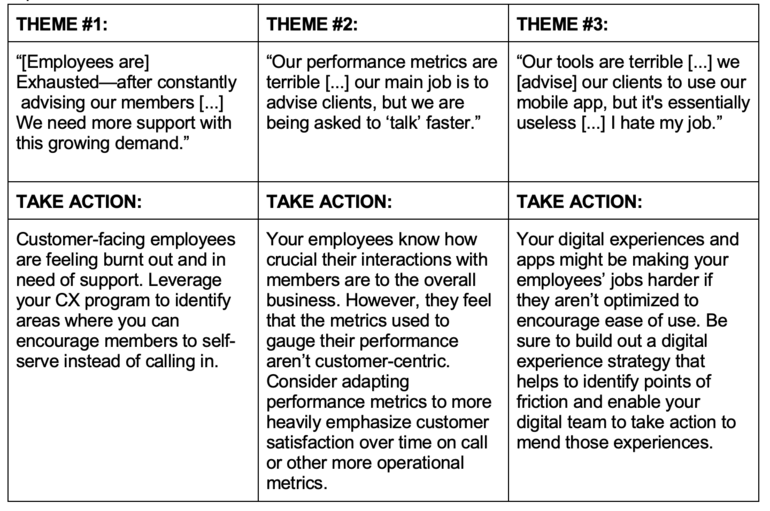
Layering in the Voice of the Employee
One of the insights we gained from the Touchpoint Impact Map was how critical your employees are to keeping existing members. But what do they have to say about their role in the member experience?
Trend #3: Yesterday’s Experience Assumptions Won’t Drive Success
It’s safe to say that financial services consumers will simply not settle for the same old experiences. With that in mind, the research also debunked a few popular customer experience assumptions as well.
Myth #1: Surveys Are the Most Important Member Feedback Method. False.
Though surveys are certainly an important way to get direct feedback from your members, they are by no means the only tool you should be leveraging. When we asked consumers their preferred customer feedback method, 33% said they would take a survey, but online reviews are much more important with 41% of consumers saying they prefer to leave feedback on a review site or social media.
Myth #2: Surveys Are Enough to Understand & Improve the Entire Consumer Journey.
Absolutely False!
This is not saying “surveys are dead.” But surveys alone are not enough to fully understand your customer and non-customer journeys—you have to bring in other signals to get the context you need to take effective action.
Let’s take a look at an example we found in the data: Starting out with a survey response:
“The staff were not attentive; no one was around to help me.”
We were then able to add in another layer of context with a consumer social signal: “Your staff look EXHAUSTED! No wonder everything is so slow.”
Things are getting clearer, but what happens when we add an employee social signal: “I’m overworked [...] My manager just gives me MORE tactical work.”
If we had merely looked at the survey response, our assumption would have been that the staff wasn’t paying attention to the member and that they were being lazy or distracted. However, when we apply the social signals, the staff are exhausted, and they tell us in their social media posts that they are feeling overwhelmed and bogged down by tactical work, and therefore unable to provide engaging customer experiences. This is why taking an Integrated CX approach is so important.
Myth #3: Members Are Not Likely to Leave as They’ve Been With Us for Years. Absolutely False. Shockingly, 44% of financial services consumers are extremely open to leaving their current bank, credit union, or financial advisor. To make matters more severe, only 25% of consumers are unlikely to leave, meaning that 75% of your members are open to better offers and services from your competitors (yikes)!
So, what can you do? Level up your experiences leveraging the loyalty drivers described in the previous two trends.
Myth #4: Consumers Find It ‘Creepy’ When Brands Use Social Signals. No Longer True.
At this point, we’ve all had this experience: you’re talking with your friends about a product or service you’re thinking about signing up for. The next day, your Instagram feed is packed with ads about that particular product or service. Creepy? Maybe you thought so at one time, but today, not so much.
Today, only 18% of consumers consider personalization to be creepy, a decrease of 57% in just three years.
Adding emphasis to this change in consumer behavior is the fact that 39% of consumers actually feel positively about personalized ads and the like.
Radi Hindawi is senior director-strategic solutions with InMoment. Hindawi is a well-known for his detailed approach to meaningfully improved experience program design and for developing and executing dynamic change strategies that involve organizational alignment, scalability, solution innovation, and customer-centric transformation. Radi is also a frequent speaker, consultant, and thought leadership author.