By Frank J. Diekmann

Imagine for a moment that in the upcoming elections the administration in the White House changes and one of the results is NCUA and CU regulation are swept under the FDIC. And the FDIC chair responds to this change by announcing, ‘Hey, I’m not sayin’ your money isn’t safe in a credit union, I’m just sayin’ my money’s not in one, if you know what I mean.”
Now, imagine the consequences. For one credit union movement, they don’t have to use their imaginations.
I spent much of last week with representatives of Poland’s credit union movement, specifically documenting work by the Via Stella Foundation—the joint U.S./Polish effort to aid Ukrainian refugees--and while most of that time was spent discussing the foundation’s work, I also learned something about an existential threat to CUs in Poland. (You can find CUToday.info's special reports here, here,here, here and here
Riding Shotgun
During the trip I spent about six hours riding shotgun in a Volkswagen van that had been refurbished as ambulance and paid for by the Via Stella as it was driven east from Bytum in southern Poland to Lviv, Ukraine, where it was then handed over to two volunteers who drove it even further to the east to areas that have been devastated by the war with Russia.
The driver who was getting zero assistance from me with the directions was Rafal Matusiak, president & CEO of Poland’s trade association, the National Association of Credit and Savings Unions (NACSCU). During the drive he shared the extraordinary events the country’s credit unions went through not that long ago.
A Fascinating History
First, some quick background on Poland’s credit union movement if you’re not familiar, because it’s interesting and relevant.
Beginning in 1989 and driven by the trade union Solidarity, communism fell in Poland just as it fell across the former Eastern Bloc and the former USSR. Led by the charismatic Grzegorz Bierecki, a former Solidarity member who once did prison time for his anti-communist activities in Poland and who would eventually become president of NACSCU, credit unions rapidly emerged in the country even though the rules and regs were loose at best.
Or perhaps I should say “re-emerged.” Before communism, credit unions were a vibrant presence in Poland. Brian Branch, the former president of the World Council of Credit Union, told me that in the mid-1930s there were more members of credit unions in Poland than there were in the U.S. The communists quashed the country's CUs after World War II.
In the early 1990s, Poland’s credit union movement also received extensive assistance from the then Georgia Credit Union League, led by now-retired CEO Mike Mercer. The partnership would become a model for U.S. CU leagues and other countries.
The Market Was Rozwój—And Then It Wasn’t
In brief, the CU business was rozwój—growing. And then a new government came to power.
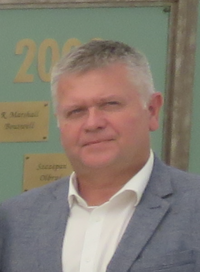
Rafal Matusiak
“At one time the government tried to eliminate credit unions in Poland,” said Matusiak, referring to changes that occurred beginning in the early-teens. “They preferred the foreign banks in Poland. It was supposed to be about the liberal, free markets. They changed the accounting rules. We lost 40% of our assets. It was devastating.”
While it was never the regulator, NACSCU was for years the primary examiner of credit unions in the country, the number of which has shrunk considerably, just as it has in the U.S. Today there are fewer than 20.
“During this bad period there were just a lot of changes in regulations,” Matusiak said. “There was a lot of negative publicity, black PR (from the government). It was suggested credit unions are unstable, that we don’t have enough capital, that there is no government guarantee for deposits.”
Polish CUs do currently operate under the same deposit insurance scheme as banks.
Eyes With a Different View
Pavel Pelc, an attorney who works under contract with NACSCU and who essentially handles government relations for the association, met with CUToday.info in the country’s capital, Warsaw, and elaborated on some of what Matusiak said.
He explained that when the supervisory authority transferred from NACSCU to the federal government and as departments reshuffled, many of those who began to oversee CUs had previously been with the central bank and some had overseen cooperative banks, the main competition for credit unions.
“They saw credit unions through the eyes of cooperative banks and had the view was that credit unions were poorly regulated and supervised and were not safe,” Pelc said.
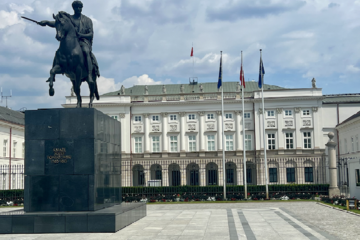
Poland's capitol building.
Then there were some difficult issues around politics, not surprising in a country and region that has been through some tumultuous political change. Credit unions, which also rose from the Solidarity movement, were viewed as aligned with labor unions by the former government, which in the early-teens was opposed by the new government. A former mayor of Warsaw was moved into a slot overseeing the supervisory authority.
‘Nearly Beaten to Death’
And, Pelc added, a future chair of the supervisory authority was nearly beaten to death by people said to be associated with credit unions. One of Poland’s credit unions was at one point taken over by people connected to the military secret service under the communists, according to Pelc.
(And people in the U.S. often suspect NCUA of “retaliation” when complaints are raised. Apparently, the Yanks are amateurs.)
In 2015 the government changed, but it did not immediately lead to big changes in the Polish supervisory authority. But there have been some small improvements for credit unions, including being overseen by a new department responsible for CUs and payments.
“The supervision has gotten better,” said Pelc. “The rules for credit unions are more reasonable and the supervisory authority is open for discussion around the needs of credit unions. Before 2015 it was looking like they were going to liquidate credit unions.”
And NACSCU has a new contract from the regulator to oversee supervision—known as “control activities” of credit unions.
A Unique Fact About Polish CUs
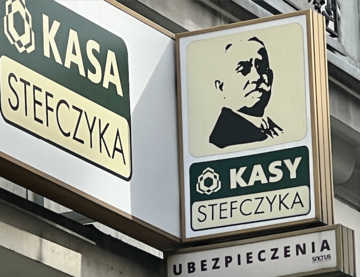
There is one other factor unique to Poland’s credit unions that will catch the attention of credit unions in the U.S.: About 85% of the country's CU assets are in one CU, Kasa Stefczyka. That credit union receives greater regulatory scrutiny and must meet a minimum capital standard of 7%. All other CUs in Poland have a 5% capital minimum standard.
And credit unions have gained a wee bit of traction with the government. Brian Branch, the former WOCCU CEO who chairs the Via Stella Foundation, noted Poland’s secretary of state did ask credit unions to continue their work on the ambulance program, which has now sent seven of the vehicles to Ukraine.
‘Understanding CUs’
Today, Matusiak says the “new government understands” credit unions.
“After 2016 we started to restore our movement,” he continued. “We are trying to find a new place for credit unions in Poland. But 40% (of assets) has not come back. Now we are working hard to move forward in a more dynamic way. But then came Covid and the war in Ukraine, then inflation and high interest rates. It has not been easy for anyone.”
Matusiak noted one of the credit unions with which CUToday.info visited, Kasa Centrum in Bytum, Poland, lost approximately 50% of its assets and members. The $25-million Kasa Centrum moved to close many of its branches, although it continues to operate 23.
Some Good News in Fading Memories
“There was high trust among our members. It’s been very hard to be attractive for new members. It was not just the black PR,” said Matusiak. “The good news was this was seven to eight years ago and many people don’t remember those messages. There is also very strong competition in financial markets and very strong community banks. Thera are also 300 cooperative banks, especially in rural areas. You don’t need to be a member to use the services of a cooperative bank.”
Beginning with the passage of the Credit Union Membership Access Act in 1998, U.S. credit unions and their associations have invested heavily in advocacy, otherwise known as lobbying. But that isn’t the case for Poland’s CUs.
“We are not as strong in advocacy as credit unions are in the U.S. We don’t have as many members (as percentage of the population),” said Matusiak. “Politicians know power. We have 1.3 million members out of a population of 38 million. But we do have a good relationship with our government. They don’t want to make problems for credit unions like the previous government. You may not like credit unions, but you can’t pass laws to destroy financial institutions that are based on trust. If you break that, you have a problem.”
Frank J. Diekmann is Cooperator in Chief of CUToday.info and can be reached at Frank@CUToday.info. Mr. Diekmann is also author of several new book, including the brand new “The Last Lyric,” a humorous satire about a murder investigation at the Rock & Roll Hall of Fame in which every line of dialogue is either a classic pop/rock song title or lyric. Available on Amazon, Apple iBook, Barnes & Noble and Smashwords. Mr. Diekmann is also author of a non-fiction compilation of the very best & worst he has seen and heard in covering more than 500 CU meetings and conferences, “501 Name Tags: How Everything You Need to Know About Business Can Be Learned at a Conference & Forgotten in the Trade Show.” It is available on Amazon, Barnes & Noble, Apple, Lulu, and Smashwords