By Frank J. Diekmann

Although I can already hear your disappointment, rather than fill this space with my words, I thought I’d share some of the observations and events from last week’s America’s Credit Unions’ Governmental Affairs Conference (GAC), including:
GAC the Place to Be
According to ACU President and CEO Jim Nussle, the event drew more than 6,000 people, including vendors, and was the largest GAC in the group’s history. It was, of course, also the first GAC not to be hosted by CUNA and the first to be held by America’s Credit Unions since the merger between CUNA and NAFCU.
Nussle said the event had approximately $9 million in economic impact on the Washington area.

The crowd at GAC.
The ‘Brainchild’
With the Bureau’s new credit card late fee rule having been announced the same week as GAC, and with its new scrutiny of overdrafts being highlighted, it was not a good week to show up at the convention center and announce, “Hi, I’m with the CFPB.”
Rep. French Hill (R-AR) told the meeting, in what has become a version of an automatic applause line, “The CFPB was created as an Elizabeth Warren brainchild in 2009 to administer compliance with rules already overseen by regulators. I think it is an agency in search of a mission.”
An Import the U.S. Could Use
During a session featuring some of the work done by the World Council of Credit Unions, Karen Bennett, CEO of Enterprise Credit Union in Liverpool, England, said her CU serves one of the three most economically deprived in the entire United Kingdom.
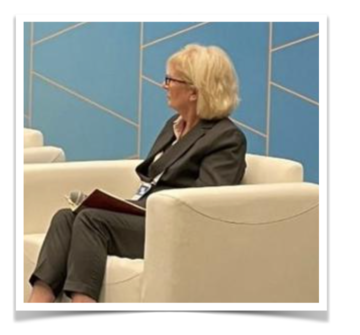
Karen Bennett
Bennett described one program at Enterprise Credit Union that requires every member to save at least £34 per week.
“We call it a lifetime savings account. And the whole idea behind it is that it is such a small amount of money that is coming in and being saved, but it’s building up over the years, so in five or ten years they have £1,000,” Bennett said. “And for some of our members, they’ve never had that access before, so, it’s been very popular.
Immigrants Helping Immigrants
During the Herb Wegner Memorial Awards Dinner, Bohdan Watral, who was previously CEO of Selfreliance Credit Union and who now chairs its foundation, noted he had come to the U.S. as a child from Ukraine. credit union’s former CEO, Bohdan Watral, who today is the CU’s chairman and who came to the U.S. from Ukraine as a child.
Today, the foundation has helped thousands of Ukrainian immigrants as the attack from Russia has now gone on for more than two years.
“We as credit unions provide services to our members in an environment that has empathy, understanding and compassion, and that’s very important. We are a guiding light,” he said. “We have helped our members have financial freedom and when people have financial freedom, they consider themselves valuable citizens of the United States of America.”
You Have to Know When to Leave
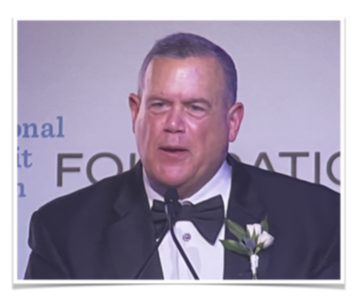
Tony Budet
Many credit union CEOs retire, and then they never leave. Tony Budet said he isn’t one of them.
In a comment that drew knowing laughs from the crowd, the Wegner-winning Budet shared that one person who had coached him during his career had instructed him on how to go away well.
“That’s a skill some retiring credit union CEOs do not possess,” Budet said.
But before he left, he also told a crowd, “I have always ended opportunities to speak to people by asking, ‘Are we lucky to get to do what we do for a living, or what?’ Yes, we are.”
Hope—And an Admonition
The Wegner-winning Judy DeLucca, CEO of New Orleans Firemen’s Credit Union, shared how the death of her husband when she was a young mother had changed her life and the career that followed.
“I had to depend on my credit union to help me survive. It set the stage for what I expected us to provide for our members in the future,” she said, before sharing stories of the incredible lengths the CU went to help in the wake of several hurricanes.
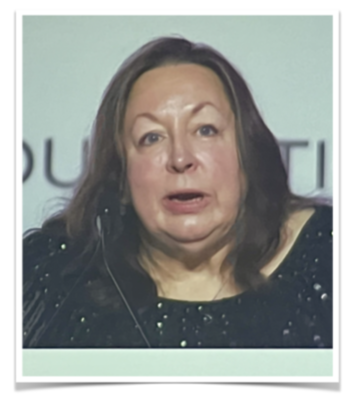
Judy DeLucca
“As a credit union, we decided that Hurricane Katrina may have washed away your possessions, but it didn’t wash away your integrity,” she said. “So, we made those people loans. We found ways to provide service and we learned our lesson. Today, we have a mobile branch with its own power system. We have satellite phones. We found a way to make it work and that’s what credit unions do.
But during a night when people can get caught up in celebration, she also cautioned, “Credit unions are not an investment club. We don’t service just A and B paper. Our job is to serve those people who are underserved, to help them build generational wealth. Sadly, as an industry we are not fulfilling our mission to the extent we could. We need to do better.”
Junky Definitions of Junk Fees
Fees and “junk fees” were an especially (un)popular topic during GAC.
During a session on fees, John Coleman, a partner at Orrick who spent more than a decade at the CFPB, said, “The White House says a junk fee is a mandatory fee that is not disclosed, which does not describe a credit card fee or an overdraft fee. I think really what a junk fee is whatever the government decides to call a junk fee.”
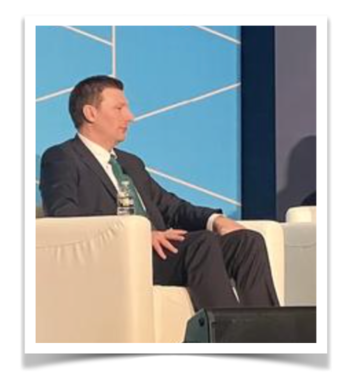
Jim Hunsanger
Later, Jim Hunsanger, chief risk officer with MSUFCU in Michigan, said that when it comes to his own credit union’s approach, “When it comes to fees, we start with our members first. What services do our members need, and how do we deliver them effectively and transparently? As we develop strategies, we ask how to make this a sustainable offering to our members. As we price out, we look at some form of cost recoupment. There is always an element of risk transfer, such as credit risk and storage risk with safe deposit boxes…At the end of the day we don’t want any services we provide to be eroding income and capital.”
What’s Up on the Litigation Front? Nothing Good
No GAC would be complete without what has become an annual tradition during which a trio of lawyers has every credit union leader rethinking their career choice.
During a session, titled “What’s New on the Litigation Front?”, Cristina Miller, an attorney with SW&M, cautioned that with NCUA is now requiring large credit unions to report overdraft fee income on their 5300s that plaintiffs’ attorneys are going to “mine the data being collected” to determine how much in fees is coming from how many members. Lawsuits may then follow.
“It really is about your disclosures. The words on the page matter,” said Miller. “But even if you disclose it properly, it may not be legal in the eyes of the CFPB.”
Brandy Bruyere of Honigman, LLP discussed arbitration agreements and noted some “state courts, in cases involving credit unions, have taken positions that ‘new’ provisions are not enforceable the opt-out may not be sufficient. Courts are looking for ‘mutual assent,’ meaning the parties both truly agreed to arbitrate.”
During the same session, Christopher Pippett of Fox Rothschild, LLP added, “The best takeaways for avoiding class action suits are review all your standard correspondence by people in default. You very seldom get sued by your good members.”
ChatGPT Made Us Do It
No credit union meeting is permitted to be held without some discussion of artificial intelligence, and GAC was no exception. Speaking to the meeting, Jennifer Goldbeck, a computer scientist who is director of the Social Intelligence Lab at the University of Maryland, said for all the good AI can do, there remain big downsides, such as AI determining someone’s credit worthiness.
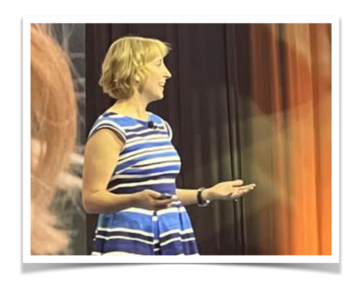
Jennifer Goldbeck
“One company…built a model that analyzed purchases and could tell when someone was going to get divorced. When that was detected it lowered the credit limit on cards. This is one of those things where people lost a lot of trust.”
She reminded that ultimately, with AI, “If you show it a bunch of human decisions in the past, it will replicate the way humans did it. AI has a veneer of objectivity, because it’s math, but because it replicates our decision-making, it replicates our biases, as well. This is probably going to be one of the first areas of regulation of AI, to require bias auditing. The problem is we don’t quite know how to do that yet.”
Speaking of artificial intelligence, or in this case the lack thereof, Goldbeck said many of her undergraduate students have turned to ChatGPT to write papers for them. They then cut and paste the text and turn it in, even when the AI says, “As a generative AI model, I can’t do this.” They leave that text in the paper, as well.
Lt. Dan’s Box of Chocolates
Actor Gary Sinise, who rose to fame after playing Lt. Dan in the movie Forrest Gump and who has since played numerous other well-known roles, he pulled from that box a career he would have never imagined when he was young, and it has led to an extraordinary life of helping veterans, first responders and others.

Gary Sinise
His Lt. Dan Foundation has raised more than $300 million after he changed the direction of his life in the wake of the Sept. 11 attacks.
He told a GAC audience his life became aa “journey from self from service. And I don’t mean selfish, I mean self. I was focused on acting and the theater company and after that tragic day I turned toward service work. I was called to a new action, a way I could serve and help our nation by supporting and defending those who defend all of us.”
Sinise shared that initially that self-service got off to a slow start. He said he twice contacted the USO years ago saying, “This is Gary Sinise and I’d like to go on a USO tour with my band.” No one called back. On the third try he said, “This is Gary Sinise, the guy who played Lt. Dan in Forrest Gump.” And he got a call back.

There were too many of these signs at GAC.
Something Fishy Here, and That’s Good
Helen Mickel, CEO of Tongass FCU in Alaska, in sharing the some of the unique challenges that face her credit union, related how the CU had expanded services to an island of 1,200 residents that was made up of mostly native Alaskans.
“Native fisherman don’t have to report income to IRS. So, we used fish ticket from local markets to verify income and approve loans,” she said.
The New Generation Gaps
Speaking to a Filene breakfast, Kim Lear, who leads Inlay Insights and who is a researcher and expert on generational trends, noted that while job offers are often written to appeal to Gen Z applicants, they should also be written to appeal to parents, whom the generation often turns to for advice.
She also urged CUs to pay attention to the “wellb3eing revolution.”
“This is the idea that if you don’t make time for wellness, you will be forced to make time for illness,
which Lear said has become a modern mantra. “It’s a mantra that has affected marketplace and workplace behavior.”
Lear said it’s a generation that also has big issues with behavior gaps between who you say you are and what you do. “I think this is an opportunity for credit unions,” she said.
A Once-a-Generation Center
Filene announced during GAC it has created the Center for the Next Generation of Membership Growth.
In introducing the new Center, which is being sponsored by Christian Financial Credit Union in Michigan, Filene CEO Mark Meyer drew a comparison to the Oscar-winning movie “Everything, Everywhere, All at Once,” saying that is the pace of change coming at credit union leaders at the same time they need to understand a new generation of members.
Later, in a nod to the pressures felt by many CUs, Meyer observed, “No CEO is happy with their CFO right now.”
Spying With Other Countries
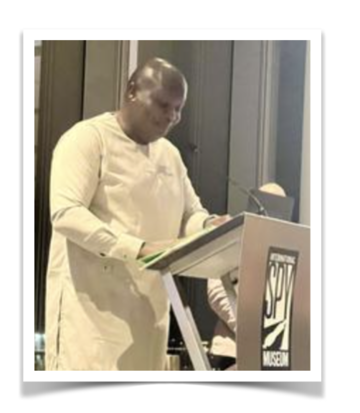
George Ombado
During an event that was held at the International Spy Museum and sponsored by the Worldwide Foundation—which also attracted a number of government ministers from countries in Africa, including Kenya and Botswana--George Ombado, who leads Africa’s credit union trade association, ACCOSCA, noted the continent is now home to 1.3 billion people, where the median age is 18.
“It’s a continent with huge potential,” said Ombado.
But Africa is also experiencing great poverty and inequality, as well as problems in education and healthcare, he added.
“Dreams in Africa have been shattered by poverty and a lack of adequate infrastructure,” Ombado said. “Without education children are trapped in a cycle of disadvantage.”
Later, at the same event, Alisa Stetsyshyn, a consultant on the USAID-funded WOCCU Credit for Agriculture Producers (CAP) Project, shared with the meeting the fate of her home town, Kharkiv, which she noted is “very unlucky to be 20 miles from the border with Russia.”
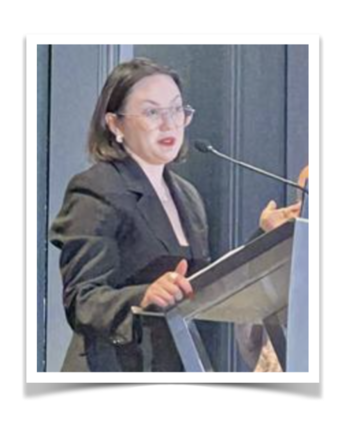
Alisa Stetsyshyn
Initially, the city’s one-time population of 1.8 million people shrunk to 300,000 in 2022 after the Russians invaded, but it has since rebounded to some 1.3 million, even though she noted, “the shelling
Stetsyshyn shared video of the city both before and after the Russian attacks.
“There has been a lot of destruction, but you can also see the hope,” she said. “People hope to rebuild and go back to a normal life. This is what credit unions are giving their members, hope, even in the most difficult times.”
It's Your Choice
Cassandra Worthy, founder and CEO of Change Enthusiasm Global, who was previously with Proctor & Gamble, told the meeting that early in her career she had become deeply frustrated and had turned to another executive to vent.
“She offered me some advice: ‘You can either get bitter, or you can get better. It’s your choice.’ As I was leaving her office I was fuming. I was thinking it’s not my choice,” said Worthy. “So, I made the decision I was going to quit. But then something happened. Those words stayed with me. I started to explore bitter vs. better and the idea that I had power. The more I stepped into this idea, I stepped into major opportunity.”
Going Viral, Like a Disease
Former U.K. Prime Minister Theresa May told GAC, "Old Joe used to sit at the end of the bar and mutter into his beer, and no one paid any attention to him. Now, he mutters into social media and it becomes a world view."
Frank J. Diekmann is Cooperator in Chief of CUToday.info and can be reached at Frank@CUToday.info. Mr. Diekmann is also author of several new book, including the brand new “The Last Lyric,” a humorous satire about a murder investigation at the Rock & Roll Hall of Fame in which every line of dialogue is either a classic pop/rock song title or lyric. Available on Amazon, Apple iBook, Barnes & Noble and Smashwords. Mr. Diekmann is also author of a non-fiction compilation of the very best & worst he has seen and heard in covering more than 500 CU meetings and conferences, “501 Name Tags: How Everything You Need to Know About Business Can Be Learned at a Conference & Forgotten in the Trade Show.” It is available on Amazon, Barnes & Noble, Apple, Lulu, and Smashwords.