

By Frank J. Diekmann
Should you ever find yourself listening to an individual member of Congress it is almost impossible not to come away thinking you’ve just heard the most common sense, down-to-earth, practical, rational, America-loving, big-picture-seeing person in the world. Yes, maybe a little heavy on the hairspray and use of first-person references, but still, what a thoughtful and balanced individual, regardless of party. The kind of person that, gosh, we ought to send to Congress.

Frank J. Diekmann
And then, apparently and painfully, everything all heads south when these otherwise reasonable individuals come together. I’m not sure if science, psychologists, or whatever supreme being you worship can explain what happens when the reps and senators arrive at Capitol Hill, but practical, rational and big picture aren’t the first adjectives that pop into mind. This must be why the capitol dome finally cracked and is now undergoing extensive repairs: even it could no longer bear the strain of what was taking place below.
It was hard not to think of all that when a parade of congressmen appeared during NAFCU’s Congressional Caucus. Nearly every speaker left the impression that he or she is the one who ought to be running for president—or perhaps it’s all relative, and I’m just comparing them to those who are currently running for president. Either way, there were numerous observations, insights, insults and more to be heard during the recent Caucus. Here’s just a bit of it:
The Gridlock Grind
If there was a bipartisan issue, it’s that “gridlock” has never been worse in Washington. T=
here is even more bipartisan agreement that it’s the other party’s fault. Saddest of all was that congressmen hailing from both sides of the aisle feel there is little that can be done about it (two people did offer some interesting insights into how to change all that, which you can read here).
Take Rep. Sandy Levin, for example (please, I hear the Republicans saying). The Michigan Democrat has been in Congress for 33 years (maybe that’s part of the problem?), but from his perspective he observed, “I think what we’re likely to see in these next couple of months is further deadlock. It’s possible we will essentially not take action and put this country once again into turmoil. I don’t think it will happen, but it’s possible.”
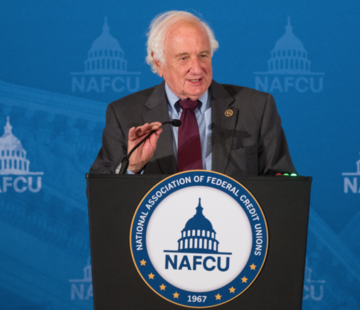
Rep. Sandy Levin at Congressional Caucus.
Levin also served up a good news/bad news scenario for credit unions, pointing out that thanks to all that gridlock there will likely be no change in the CU tax exemption. But that inability to move any legislation forward also means other credit union priorities in Congress are going to see about as much activity as the residents of the capitol’s Statuary Hall.
Levin articulated what many feel so strongly, that “we have a substantial percentage of the population that is disillusioned with the political process, and I’m concerned with how that is going to work out.” And yet, ultimately, he remains optimistic.
“I have a deep faith that in the end democracy in this country is so deeply a part of our fabric that we will come out on top,” he said.
Enjoy Your Last Trip to DC
Rep. Bill Posey (R-FL) found a pretty powerful way to make his point about the costs to credit unions of regulation. After reeling off statistics on the number of CUs that have disappeared in recent years, he said, with a bit of exaggeration unless he knows something about the CUs that attend Caucus, “Half of you won’t be back here at the end of my next term should I be re-elected.”
Posey was one of many Republicans who took swipes at the Dodd-Frank Act, finding a receptive audience for the message. He called it a “sorry” piece of legislation now largely enforced by “unelected and unaccountable bureaucrats.”
And Posey showed that when it comes to NCUA, he includes the agency among that group. “I call NCUA ‘Nuke-you-a,’ because I think they are nuking you,” he said.
You Kids Need to Stop Fighting
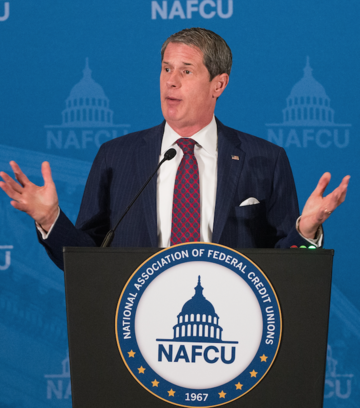
Sen. David Vitter at Congressional Caucus
Sen. David Vitter skewered Dodd-Frank as well (Congressional Caucus was a regular Dodd-Frank rotisserie, actually) and told CUs that small, community banks are every bit as endangered as a result “We’re going to become just like Canada, just like Europe,” with a limited number of large banks only.
Speaking of CUs and small banks, Vitter urged both groups to drop their fight with each other.
“I think it’s a circular firing squad. I think it’s a mistake for community banks to focus on the CU tax exemption and for credit unions to focus on limiting banks on business loans, especially when you are surrounded by much larger financial institutions,” said Vitter. “And I tell the bankers the same thing.”
When another audience member said all he wanted was a “level playing field” with community and regional banks when it comes to business lending, Vitter replied, “That’s exactly the argument I get from community bankers when it comes to your tax status. So be careful about what you ask for.”
Dodd-Frank? Not Going Anywhere
If nothing else, Sen. Sherrod Brown (D-OH) gets credit for not sucking up to the crowd. While other congressmen were ripping Dodd-Frank, Brown said he is a “supporter” of the legislation and that there is no chance it will be repealed. Credit unions, he said, would be better served by focusing on getting more relief for institutions below $10 billion in assets.
“Want to tier the rules? No reason we can’t do that. You are being held hostage to a partisan agenda,” he said, adding he is “hopeful for a modest Dodd-Frank reform bill” in the current Congress.
And While We’re At It…
Rep. Patrick McHenry (R-NC) also pulled few punches when it came to Dodd-Frank or NCUA.
“You need to have a wise and good regulator that understands your industry,” McHenry said, as he paused for effect and let his audience laugh. Then he added, “I concur.”
The Holy Writ
A senator who was not a speaker may have been the biggest presence at Congressional Caucus. Numerous Republican members of Congress made references to Sen. Elizabeth Warren (D-MA), the architect and chief protector of the CFPB, although for many she was like an unnamed Voldemort. Vitter said she “scares the bejesus out of her Democratic colleagues and they run like the building is on fire,” while Rep. Bill Huizenga (R-MI) made a less than veiled reference to Warren when he said, “We have a problem in that there are some loud, prominent voices in the Senate. Not to name names, but a New England senator also has said there will be no changes to Dodd-Frank. I missed the time when this was named Holy Writ from the heavens that shouldn’t be changed.”
Welcome: Now Go To Your Rooms & Don’t Speak to Each Other
WASHINGTON–The divisions in Congress begin early, according to one representative who said he is trying to change that. Rep. Patrick Murphy (D-FL) recalled that when he recently arrived in Congress he discovered that members are “segregated” into one room for Republicans and another for Democrats. And that’s where they spend their next three weeks, he said.
The Business is Governing; Governing Isn’t Business
With Donald Trump still leading GOP presidential candidates, Rep. James Clyburn (D-SC) addressed all the calls for government to be run more like private business. He isn’t having it.
“There is always a battle between efficiency and effectiveness,” he said. “I hear people say, ‘You’ve got to run government like a business.’ I could not disagree with that any more than I do,” he said. Government is not in the business of making a profit. We are in the business of effectively serving communities' and people’s needs. If you really want efficiency, I tell people you want one-person rule. That’s the most efficient government you can have. You may not like it; but that’s efficiency.”
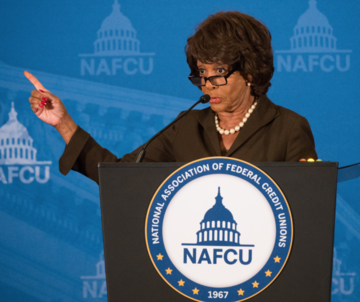
Rep. Maxine Waters at Congressional Caucus.
Clyburn said he is able to speak to speak more freely thanks to the advantage of having recently turned 75. “There is a great benefit in that you just don’t give a hoot. I want my government to work and to be as effective as it can be; I want to plan for our children and our grandchildren and do it in a way that will have a positive impact on their lives and communities.”
'Pie In The Sky' & 'Ridiculous Proposals'
As an end-of-the-day speaker, Rep. Maxine Waters (D-CA) basically told Caucus-goers to forget just about everything they had heard that day.
“You’re going to hear a lot of talk. Some people will talk about relieving you of ALL these regulatory burdens,” she proclaimed. “It’s pie in the sky. What you need is real honesty on regulatory relief, and you do not to be tied in with others, that somehow you are all in this together with those ridiculous proposals they have. You don’t need to be used by anybody. We can do for credit unions what doesn’t need to be done for the biggest banks in the country. You don’t need to be tied to them.”
Frank J. Diekmann is Cooperator in Chief at CUToday.info and can be reached at Frank@CUToday.info or @FrankCUToday.