

By Frank J. Diekmann

Two questions for you. If one was considered an aberration, and two suggests a trend, what in the world will the reality be for Credit Union Land when three rolls around? Or four and five and… And will anyone in the leadership of credit unions ever stand up and actually lead?
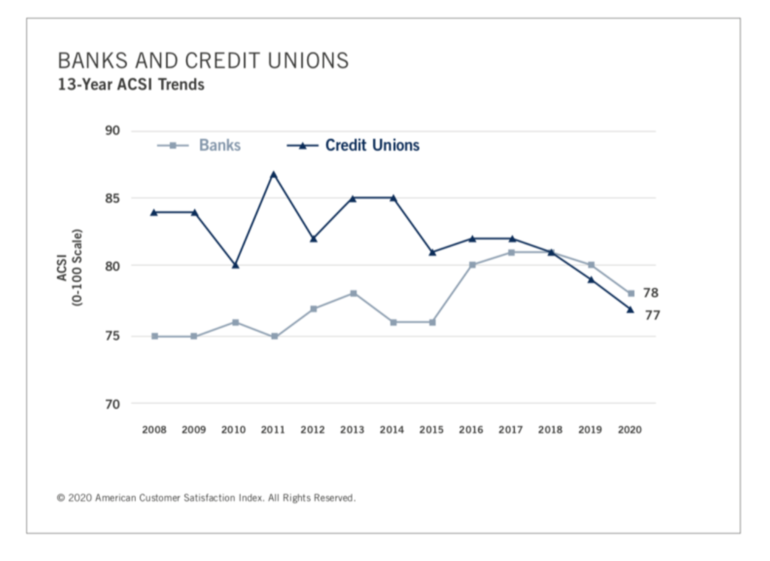
I pose those two questions after the latest American Consumer Satisfaction Index (ACSI) survey found for the second year in a row credit unions have been rated below banks when it comes to consumer satisfaction. That’s below, as in “worse than.”
When CUToday.info was first to report the ACSI survey findings in 2019 it also marked the first time in history credit unions had ever fallen behind banks. In response, a year ago in this space I wrote, “…It seems the CU community has been giving (the findings) the old ‘nothing to see here, move along, move along’ treatment. Behind banks on service. The same banks that are the butt of comedians’ jokes anytime they need a go-to punchline about being treated coldly. The same banks one other group goes to the well for even more often than comedians when they need an applause line or want to pat themselves on the back—credit unions.
“Hey, credit unions—it’s way past time to stop the patting.”
But the back-patting not only never stopped it became ambidextrous, and the impression within credit unions seemed to be the findings of the ACSI survey, which is conducted by the University of Michigan in conjunction with the American Society for Quality in Milwaukee and CFI Group in Ann Arbor, Mich., were some sort of aberration, a one-off.
I don’t know if there is such a thing as a “two-off,” but let’s forget the terminology for a moment and instead focus on what the 2020 ACSI findings represent. As CUToday.info reported here, credit unions not only finished behind banks on consumer satisfaction for a second year in a row, CUs hit a “historic low” in the respected survey.
Credit unions fell 2.5% to a score of 77 on a 100-point scale in the 2020 ACSI. Banks were given a score of 78, and some will no doubt dismiss the results by arguing it’s not as bad as it seems, as banks and CUs are statistically tied. Hey, CUs, grab a mirror and take a look at yourselves: when did tying banks on satisfaction become the standard? Too bad there’s not a CUNA GAC in 2021, because I have a slogan: “America’s Credit Unions: Within the Margin of Error for Service Equal to That of Banks!”
Here are a few more questions, and I regret to say I posed most of these a year ago but have yet to hear any proposed answers (let’s blame COVID):
Q: If The “Digital Disruption” is to Blame, How are CUs Responding?
In recent years “digital disruption” has been the subject of CU meetings (disrupted themselves) and webinars more often than compliance updates, and the dire warnings were all about upstart fintechs siphoning off the youngest and best CU members. While a little of that has occurred, it’s been the big banks that have poured billions into their digital apps to do the disrupting. The ACSI survey found CU websites lost ground for a second year, with satisfaction waning 2% to 82, (banks were given a score of 84). Mobile app quality (82) for credit unions also slipped for a second year showing a net loss of 4% since 2018.
The top 500 CUs by assets may have invested the kinds of dollars required to improve their e-channels (because they have it), but when the $132-billion Navy Federal is a patrol boat among the mega-bank aircraft carriers, what are the other 4,500 (much) smaller CUs to do? How do they compete? The answer would seem to lie in “cooperation among cooperatives,” yet the only time we see it is on the lists of the 7 Cooperative Principles that are resurrected every International Credit Union Day and then dutifully put back in the closet.
Q: Do Bigger CUs Mean Smaller Members?
In 2019, I pointed to several CU mergers that CUToday.info reported the same week the ACSI findings were released. In 2020, the same two news events overlapped again, mostly involving smaller CUs disappearing forever into larger operations, accompanied by press releases listing all the usual reasons. But that’s the management view; what’s never mentioned is the members’ view. As I wrote then, “…You simply feel a closer familial bond to a place that has your employer’s name in it. Or the name of your hometown. Or the place your parents took you as a kid. Every merger is a micro-disruption, and after a while all the micros become a macro.”
And none of that takes into account “members” who “join” thanks to an indirect auto loan but who feel no direct connection to some company somewhere to which they make payments.
The question: Has the membership boom of the recent years come at a long-term cost? And what can be done about it?
Q: Where is the Leadership, 2.0?
Again, a year ago I pointed out the response from the CU trade groups to the survey findings was immediate and forceful, with both major trade groups and the state associations vowing it was time for some self-reflection and recommitment to core values and to pragmatic member service training and improved electronic channels. Aaah, who’s kidding who? As I stated then and will do so again here, the real response was the kind of silence that had crickets asking, “Hey, is it just us or is it pretty quiet around here?” A year later, the crickets are still asking, as am I. And so should you.
Where is the trade group leadership? After two years, the trend seems pretty obvious and it’s no longer a trend, but a reality. Instead of spending tens of millions of dollars on a fancy media campaign, far less could be spent on some basic member-facing service channel improvements and training that would drive far greater returns.
CUs plow millions of dollars into “advocacy” every year supposedly to grease the skids in a gridlocked Washington. Who’s advocating for the broader CU movement in the U.S.? For members? For non-members who may be ripe for membership, but hey, they no longer see a measurable difference from their bank. Credit unions don’t just want to fill their lobbies with the dissatisfied; often, those people are dissatisfied for reasons of their own making.
Here’s another question: Who’s advocating for small and mid-size CUs? If you fall into this category I think you already know the answer. It’s time you quit waiting on others to lead on this issue and champion the cause yourselves. If you’re looking to connect with another CU leader to tackle this broad “satisfaction” challenge, let me know and I’ll connect those I hear from.
A Final Question
A final question: You know all the cutting edge wisdom CU leaders are given about the imperative of getting out of a comfort zone? Well, consumers are more satisfied with their banks than they are with credit unions. Are you comfortable with that?
No doubt there are some of you who are responding to all this by dismissing what’s clearly taking place. “It's not our credit unions,” some will say. “Our members love us!” Do they really? Or is it just a self-reinforcing prophecy because you only hear from those who are still around and not those who quietly slipped out the Closed Account door. (Or worse, the Never Opened door.)
Change never applies to you or your organization until it does. Or more fittingly, until it did. And by then the only question left to be asked by those who are still around is, “Hey, what happened?”
Frank J. Diekmann is Cooperator in Chief at CUToday.info and can be reached at Frank@CUToday.info. Diekmann is also the author of “501 Name Tags: Everything You Need to Know About Business Can be Learned at a Conference and Forgotten in the Trade Show.” For info: www.501nametags.com.