By Frank J. Diekmann
I don’t want to brag (too much), but together, Bill Gates and I had a pretty good year last year. The two of us watched as our combined net worth reached $79.3 billion or so (give or take a decimal point, Bill and I don’t really worry don’t like to get down into the weeds where money is only measured in hundreds of millions of dollars). Moreover, and, I say this with even more humility, together Billy G and me have now donated about $28 billion to charity.

There’s was age-old saying in the newspaper business that something could be true but also not be accurate, and if you need an example I encourage you to go back and read the first paragraph again.
Here’s another much more relevant example: “Credit union membership growth was on a tear during the first two months of 2015…adding 800,000 new memberships versus the 500,000 reported in the first two months of 2014. Credit unions should expect membership growth to exceed 3% in 2015. This will push the total number of credit union memberships to 104.5 million by year end, which is equal to 33% of the total U.S. population.”
The statement, above, is from CUNA Mutual’s February Trends Report, and it sums up a bragging point for credit union of the last few years. It wasn’t that long ago that 100-million total members was a far-off goal; now it’s disappearing in the rear view mirror. And yet…
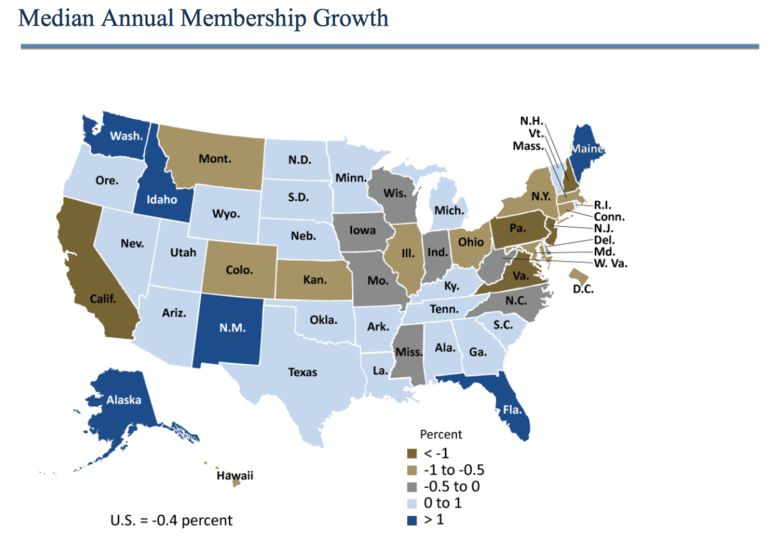
Consider this statement from the state-by-state report released by NCUA late last week. “While overall membership in federally insured credit unions continued to grow in the year ending in the first quarter of 2015, the median growth rate was -0.4%, essentially unchanged from a year ago,” NCUA said. “Overall, 53% of federally insured credit unions had fewer members at the end of the first quarter of 2015 than a year earlier. Credit unions with falling membership tend to be small; about 75% had less than $50 million in assets.”
I’ve used this space on numerous previous occasions to highlight the disparity in growth rates between large and small credit unions that is almost always lost in all the noise around the new membership. But here’s another trendline released in the NCUA state report: “In 23 states, the median membership growth rate for federally insured credit unions was negative.” For the record, Alaska (3.1%) had the highest median membership growth rate, followed by Idaho (1.9%). The median membership growth rate was lowest in Virginia and Pennsylvania (both -1.9%). See the chart at the bottom of this column.
Of course, Virginia and Pennsylvania could easily change that. I’ll talk to Bill about joining a credit union in one of their states (where he will tank some CU’s net worth ratio).
'I Thought I Knew This Generation And I Don't'
Here’s some observations from the Reporter’s Notebook that I’ve gotten a little behind on…
For the past year PSCU has been engaged in a large, behind-the-scenes project with a group of “Possibility Makers” who have been researching and collaborating and brainstorming to create its just-released “Playbook,” which contains various tools, resources, and templates all aimed at helping a credit union advance its digital strategy. You can find the full story here http://www.cutoday.info/THE-boost/PSCU-s-Possibility-Makers-Introduce-a-Digital-Playbook
The research piece included focus groups with Millennials, out of which came some surprises. As one of the Possibility Makers, Joel Richard, said, “I’m a Millennial and I thought I knew this generation and I don’t.”
Another Possibility Maker observed of the focus group, “An a-ha moment for me was that the Millennials are very concerned about data breach. I also really thought going into this that they really want access to everything on their phone. But they actually want access to traditional brick and mortar, not that they would go to it frequently, but they liked to know it was there if they needed it. When asked about phone, they said they were concerned about data breach and talking to people about making wise financial decisions.
Another of the Possibility Makers offered this: “Of the five Millennials at our table, two of them were completely unbanked. No financial institution that they called home. This is our future. Where are they doing their financial services? After we met with them PSCU did a fantastic job of gathering all the insights and came up with this list, prioritized. The number-one thing on the list, which I felt was shocking, was Millennials want a place that they can trust. They felt like going into a financial institution was like going into a car dealership. That’s not at all what credit unions are all about. So that was really eye-opening.”
And finally, one other Possibility Maker noted, “One thing I heard form the Millennials is ‘You have the information on me, why don’t you present solutions for the challenges I have?’”
Frank J. Diekmann is Cooperator in Chief at CUToday.info and can be reached at Frank@CUToday.info.