

By Frank J. Diekmann

Like so many others during the Great Depression, with banks failing all around them and credit hard to get, a group of working folks and farmers in rural Minnesota had gotten word of this new kind of “bank” that had taken root on the East Coast a couple of decades earlier and which had begun to spread its tentacles westward.
It was the same decade another group of like-minded pioneers from all corners of the U.S. would journey by steam train on sleeper cars to Estes Park, Colo., to form a new group with the somewhat unwieldy name, the Credit Union National Association.
Now, some 90 years later, the grandson of one of the men in Minnesota who bonded together with his siblings to help to charter a new credit union, is the chairman of that same trade group.
Troy Stang, president/CEO of the Northwest Credit Union Association, which represents CUs in Washington, Oregon and Idaho, officially took the CUNA chairman’s gavel during the recent Governmental Affairs Conference in Washington.
It’s a job, Stang told attendees at GAC, that’s “in my DNA, in my roots.”
A CU Resume
Indeed, Stang began his own credit union career at that same CU his grandfather chartered in central Minnesota, where he worked in management at St. Paul's Hiway FCU. He would go on to become a senior VP with Arizona Federal Credit Union and vice president of the then Texas Credit Union League. In the middle of those credit union posts, from 2003-06, Stang served on the senior political staff at the U.S. Department of Treasury during the George W. Bush administration. Later, he would join the Northwest Credit Union Association, where he was named CEO in 2012 after the Oregon and Washington leagues merged to create the NWCUA. He first joined the CUNA board in 2013.
Each new CUNA chairman brings something over which he or she is passionate, and in Stang’s case he told me when we sat down to talk in the Washington Convention Center he comes to the job “prepared to leverage our voice like we never have before. I don’t want to miss the opportunity to have an aligned voice. I want to align with facts and data and tell our story in a different and compelling way from other groups.”
Prove It
Stang admits there is no shortage of storytelling around telling the credit union story, and it was something of a theme at GAC itself. But credit unions in the Pacific Northwest have proven to be good at weaving the cooperative tale; Washington is the only state in the country where more than 50% of the population belongs to a CU, and Idaho and Oregon consistently lead the nation in membership growth.
Stang wants to add another chapter added to that story; credit unions able to prove the story, to show how they live it.
“We know ourselves and we know that what makes us different is our structure,” he said. “But if we can’t show in tangible ways the differences, then we shouldn’t exist. We have all the economic studies and community impact reports. Credit unions have hearts of gold, but they are humble and don’t talk that much.”
As an example, Stang points to the approximately 175 credit unions in the Pacific Northwest that collectively belong to more than 6,600 community organizations.
“Can you imagine if credit unions didn’t exist? Those communities would crumble,” he said. “We need to produce real, tangible value,” such as how CU rates and fees compare to those of banks and how members directly benefit with money in their pockets.
The Value of Video
But that story is about more than rates and fees. The Northwest CU Association has also been quick to leverage the newest storytelling medium for making abstract concepts, such as not-for-profit and cooperative status, feel more tangible: video.
“Videos are a great way to tell the member story,” he said, not needing to add they are especially popular with younger consumers.
During GAC a video created by the NWCUA was shown to the full meeting. It told the story of how a bank had pulled out of Union, Ore., a town of just over 2,000 people in the eastern part of the state, creating what’s often called a “financial desert” and an economic downward spiral for the community. Old West Credit Union stepped in and opened a branch, and in the video—produced by former NCUA board member, Oregon senator and Portland TV broadcaster Rick Metsger—townsfolk talk in real terms about what the CU branch has meant.
That kind of story-telling may feel good, but Stang says it works well, too.
“With elected officials, if you go in (to a meeting) talking about the power and authority you are seeking, that is not effective. An elected official wants to know how it effects the consumer.”
‘Stretching the Movement’
While Stang has clearly been influenced by his time with the Northwest Credit Union Association—he had the requisite coffee with him when we spoke—he said the CUNA chair’s job is to serve the “entirety of America and the credit union family.”
If he has a strength, Stang said it isn’t anything regional, but instead, “I believe what I bring is the skillset needed to stretch the movement.”
I asked Stang about one complaint I often hear leveled against leagues and national trade associations, which is small- and medium-size CUs believe they don’t matter, as the “haves” credit unions increasingly have more, pay the most dues, and get the most attention.
“It doesn’t matter where the credit union is, who the membership is; all that matters is serving the membership,” said Stang. “Assets and asset growth doesn’t matter. Whether small, medium or large, it’s the same structure.”
The Need to Stay Relevant
As for which credit unions the trade groups best represent, Stang argues it’s all credit unions.
“When I started 30 years ago at a small credit union, we had no idea the kinds of products and services consumers we were going to need and ask for today. The push at that time was more from a transactional perspective,” Stang said, remembering when CUs had to make a major effort to gain the authority to offer share draft accounts.
“What I tell any credit union is I’m not smart enough to know what we are going to need, but we all have to stay relevant.”
Stang said he does appreciate how hard it is to run any credit union of any size, and especially understands remaining competitive at a smaller credit union is an extra bag full of challenges itself.
“It is very hard if you have a small operation,” Stang agreed, saying the best way to respond is, “You have to be at the collaboration table.”
Those kinds of tough roads are shared by many, he said, but are made easier when each person, credit union or system organization “takes a turn carrying a flag for a piece of the journey.”
‘I Invite Banks to Convert’
Then there’s the matter of increasing banking industry criticisms of credit unions, whether over acquisitions of banks or the accusation large CUs no longer fulfill their “mission.” Indeed, at the same time we were speaking, the bankers’ trade groups were papering Capitol Hill with exactly those messages.
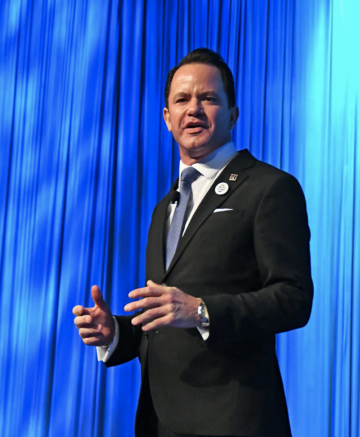
Troy Stang speaking to CUNA's GAC.
“I invite any bank to convert to not-for-profit status,” said Stang. “If an elected official knows who we are and what we are and they can see it working,” they won’t be swayed. “Elected officials are very, very smart and they see the value to the consumer. Why would they want to tax us? It makes no sense.”
Meanwhile, as the banks were spreading their message, credit unions were continuing to do the same with CUNA’s Open Your Eyes awareness initiative, according to Stang. He said credit unions have gotten “huge traction” with Open Your Eyes, saying it speaks to a lot of misunderstandings and myths about credit unions.
“When consumers see who we are and what we are, it is fascinating. Once they get it they start asking themselves, ‘Where do I do my business?’” Stang said.
When asked about the fact membership growth has actually slowed down since the Open Your Eyes campaign made its debut (during GAC CUNA announced it is halfway to its $100 million funding goal for the effort), Stang wasn’t discouraged, instead saying, “That should be the fuel for our engine. There is the need to do more advocacy and to support Open Your Eyes. When you educate consumers, they want in.”
Keeping the Faith
What those non-members who find their way into a CU will discover, according to Stang, who remains a stalwart optimist about the role of financial co-ops, is “credit unions help people manage between paychecks and achieve life’s dreams.”
I suppose the optimism shouldn’t be such a surprise. The credit union his grandfather helped found all those decades ago had a faith-based field of membership. Nearly a century later, his grandson is keeping the faith.
Frank J. Diekmann is Cooperator in Chief at CUToday.info and can be reached at Frank@CUToday.info or @FrankCUToday.