

By Frank J. Diekmann
Having had time to unpack after the World Council meeting in Belfast, Northern Ireland (where CUToday.info was the only independent CU news publication on hand providing coverage), here are a few nuggets discovered amidst the green T-shirts and bottles of Jameson:

- There were 55 countries represented at the WOCCU meeting, with the U.S. the largest delegation. WOCCU said it estimated the meeting meant $5 million to the Belfast economy. Overall, there are 57,000 credit unions in the world operating in 105 countries, WOCCU said.
- The credit union movement in Ireland has 14 billion Euros in total assets, 1.3 billion of which are in Northern Ireland. One representative of Ireland’s CUs said they also have “ambitions in Ireland to be major players in social housing.” Approximately 3.3 million people in Ireland belong to credit unions, and having driven around much of the country it’s hard not to notice there is a credit union to be found in the city centre of just about every town and village.
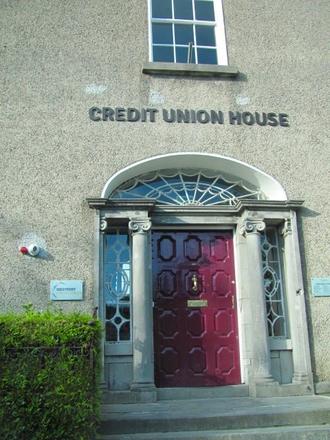
Credit Union House in Westport, Ireland.
- Camilla, duchess of Cornwall, who is better known as the wife of Prince Charles, is also known as a vocal proponent of financial services for the unbanked in the U.K., where she noted two-million people have no access to a bank account. In a video welcoming attendees to the WOCCU meeting, she further added, “I’m a passionate advocate of credit unions.”
- Development Educators (DEs) in the European program during the Belfast meeting contributed their time and effort to assisting a local homeless charity, the Welcome Organisation. DEs helped by painting, wallpapering, filling holes, preparing and cooking Sunday lunch, organizing the donations room, and setting up an eBay shop and helping with the design of a newsletter. In addition, because at this time of year the charity runs out of essential items, including toiletries, sleeping bags, cups, towels, and more, participants were urged to donate the hotel toiletries in their room each day. At the registration area of the meeting, the DEs also created a “pop up shop” in which items handmade by local, homeless residents were for sale.
- On a typically Irish day of overcast skies and rain, I asked a cabbie in Limerick about the sun. In the Irish brogue you’d expect, he responded, “Aye, that orange thing in the sky? Just a rumor.”
- We’ve become accustomed to seeing it in the U.S. that we don’t notice when it’s not there, but a tip of the tam o’shanter to the Irish for cleanliness. There is hardly any litter to be found, putting the emerald in the Emerald Isle.
- Europeans have long been more energy aware than Americans, where we drive around parking lots trying to get spaces that are one row closer even though most of us could use the walk, and turn the air conditioning down so we can make use of the fireplace. That has everything to do with the cost of energy in Europe being much higher than the U.S. As a result, in Ireland you see examples of energy efficiency every day.
The engine on my rental car, a Skoda, would shut off when stopped if I removed my foot from the clutch (it restarted on its own when the clutch was engaged). In many hotels, the hallway lights remain off until your motion turns them back on. Escalators run at a slow speed until someone steps forward, and then they run at a normal pace. Every electrical outlet has an on/off switch. And in much of Ireland, most places have no air conditioning—as many Americans discovered at their hotels when unusually warm weather hit Belfast during the WOCCU meeting.

Few countries deliver on postcard scenery like Ireland.
- It wasn’t that long ago that no reasonable person would have even suggested Belfast as a host city for a conference, unless you were selling terrorism-related products. The city, along with Northern Ireland, was consumed for decades by a bitter fight with the U.K. and between Catholics and Protestants that are still most understatedly referred to as “The Troubles.” The Friday Peace Accords have largely put the bitterness (or at least its displays and violence) to rest and become a model for peace negotiations elsewhere, but memories remain strong and emotional for many and there were numerous references by various speakers who hailed from Northern Ireland to that period, and the critical role played by CUs in helping so many working class and low-income Irish on both sides of the fight during that time. You can read more about that here.
- I was told by one person that half the population of Ireland is below the age of 25. And if walking the streets of Belfast counts as a demographic study, that certainly seems to be the case.
- As I noted last week, “globalization” was evident both literally and metaphorically at the WOCCU gathering. How the world is getting smaller and integrated was evident not just in the thought-provoking and provocative insights of Ian Goldin, which you can read more about here, but by Mr. Goldin himself, who noted that the day prior to speaking to the Belfast audience he had been kayaking in Botswana.
- This story was shared by Brian McCrory of Northern Ireland, who is WOCCU’s second vice chair: “Years ago, my teacher was a man from Derry, and every week as part of our math lesson he would ask to count coins. It was only after quite some time that we began to understand exactly what he was up to. He was a founding member of a local credit union and we were assisting him in counting the take. He was a smart guy, in more senses than one. Part of the legacy that he left, which I didn’t recognize for perhaps 25 or 30 years, is that he instilled something about credit unions in my head.”
▪ One of the great and striking ironies every time the World Council hosts its meeting is that it’s such a strong supporter of the Global Women’s Leadership Network, which held meetings in conjunction with the Belfast meeting, but it has almost no women in its own leadership.
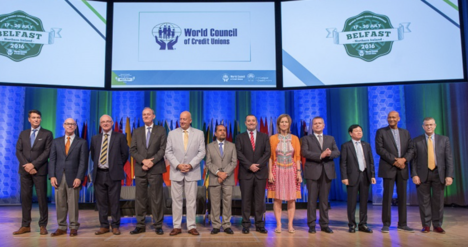
The 'new' WOCCU board.
When WOCCU introduced its new board, all but one of its 12 members was male. It lost one female when Anne Cochran of the Louisiana league (who was born in Ireland) left as chair, but it added one new female member when Martha Durdin of the Canadian Credit Union Association was named to the board.
WOCCU’s board works a bit differently than others, as its members aren’t elected. Instead, they are appointed by the member nations that support the World Council, the biggest of which is a certain country in which you likely reside, and a certain trade association to which you may belong. It’s time for that group to ensure more women are appointed to the board, and not just because more than 50% of the world’s population is female. You can’t hold conferences where you’re tripping over handouts announcing women’s empowerment sessions as you make your way to a presentation on diversity when you’re about as diverse as the line-up of patrons I saw with elbows on the bar and draining their Guinness in the village pubs.
▪ Speaking of the WOCCU board, the new chairman is Daniel Burns of Canada. Patrick Jury of the Iowa league is first vice chair, and Brian McCrory, as reported above, is second vice chair. Secretary is Manfred Dasenbrock of Brazil and the Treasurer is Bruce Foulke, CEO of American Heritage Credit Union.
In his first remarks as chair, Burns said, “I was reflecting recently on how our movement and WOCCU have changed since the 1990s. We used to exist more in isolation of each other. In certain respects, those were the good old days. Now bank failures have brought us the gift of global bank regulation. Now, more than ever we must bind together to manage this new threat to our movement. Our work has just begun. We now have a global message. WOCCU is best positioned to leverage the assets of our members. There is a better way; do not regulate the what, but the how of banking, and begin by asking why.”
- I’ve often wondered if there is any statistic you can just toss out there with some confidence as a conference speaker, and the audience will just write it down. For what it’s worth, here is the Factoid of the WOCCU meeting as put forth by one person: “For every hour spent sitting, 22 minutes is taken off your life.” The irony was her audience was seated at the time.
- It’s all but scripture in the U.S. that “no one knows what credit unions are.” I would never want to question scripture, but that’s pretty debatable given that 107 million Americans belong to CUs. But setting that aside for a moment, have you ever had one of those conversations about credit unions with a stranger that are almost surreal? At a restaurant near my hotel in Belfast, a waiter asked why I was in town. When I responded it was for a credit union conference, he actually said, “Credit unions! They’re fantastic. There are portions of Belfast that would be in dire poverty without them.” What made that even more interesting was that he went on to ask exactly how credit unions work, but also knew that some were “having some trouble” because they have too much on deposit.
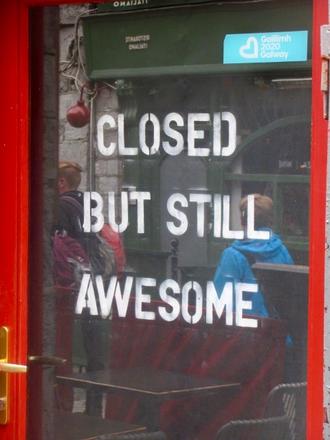
Best sign seen in window.
- The merger pace among Ireland’s credit unions has been nearly as brisk as that in the U.S., with some suggesting (often, strongly) that one government body is pushing a merger agenda. David Matthews of the Irish League said, “Today the word merger is on everybody’s lips. There is a belief that bigger is better for all the usual reasons. However, the proposition that bigger is better is not yet proven, and our own regulator has said she has not yet seen the benefits of the mergers.” The average size of credit union in Ireland is 30 million Euros.
- In conversations, especially at social events, with people from Ireland’s credit unions there was a lot of interest in what’s going on with presidential politics in the U.S. and especially with Donald Trump. The building of walls is still a fresh memory for many in Ireland, where Northern Ireland was divided for many years by a wall guarded by paramilitary troops. I still recall men with machine guns looking through and under my car when I visited in the early 1990s. Now, with the Brexit vote, the wall may need to go back up again, as Northern Ireland is part of the U.K. and the Republic of Ireland is not. “It’s just rubbish,” I heard more than once.
- George Bernard Shaw famously observed once that “England and America are two countries divided by a common language.” Indeed. The driver of my hotel/airport shuttle sported a vest reading, “Flight Disruption Team.
Frank J. Diekmann is Cooperator in Chief at CUToday.info and can be reached at Frank@CUToday.info or followed @FrankCUToday.