

By Frank J. Diekmann

How nervous are your direct reports to ever make a mistake? What is your reaction? Does your credit union or organization prefer to avoid innovation rather than have a failure?
If that’s the case, avoiding individual failures is the most likely way for the entire enterprise to fail in the long run, according to one person.
Beth Comstock, the former chief marketing officer with GE and president at Integrated Media at NBC Universal, told CO-OP’s THINK meeting that she, too, has heard every excuse when it comes to reasons something couldn’t be done by an organization. And she’s heard that from both subordinates and superiors.
“’No’ to me has come to mean ‘Not Yet.’ I’ve learned you have to give out permission slips. I think they are important and I like the symbolism. When I was at GE I literally printed them out and when someone was fearful or afraid to try something, I gave them a permission slip. How could you encourage a colleague? If you could give a gift of permission, what would it be?”
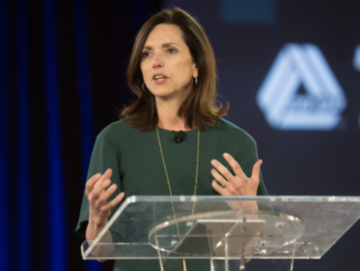
Beth Comstock speaking to THINK.
Comstock said she learned during her career her job wasn’t to be a manager, but instead to be the coach of a team of collaborators.
Other observations made by Comstock:
- “With my team we had ‘Fail Conventions’ with brown bag lunches and webcasts. We would share our failures and talk about how we messed up. What we created was vulnerability and trust, and that’s a challenge I give you. Rather than saying ‘What do you do?’, ask ‘How did you fail and what did you learn?’
- “Your job as a leader is to paint a vision of the future and then encourage your team to fill it out. Teams need to be built around these missions, not the hierarchical structures. And the job of team members is to tell me what I don’t want to hear. Commit to telling one another what you don’t want to hear.”
Comstock’s full remarks can be found here.
What? Good News in Compliance?!
When the word “compliance” is used in credit unions it is invariably joined with “burden,” as if the words have merged into “complianceburden” and are now just one word, not to mention one state of mind morphing into bad mood.
Why, with all the talk (and worry) about artificial intelligence eliminating jobs, isn’t compliance on that list? Talk about a job just about everyone would all too happy to turn over to a computer.
So, some good news on the AI front: compliance isn’t immune, according to futurist and author and fintech advisor Chris Skinner.
Skinner, who has forecast that one-in-three jobs in financial services today will be automated by 2025, predicts that compliance jobs will be among those being e-pink slipped.
“That doesn’t mean it’s a bad thing, we are going to create new jobs,” Skinner told CO-OP’s THINK Conference recently. “Fintech employs thousands of people and yet it didn’t exist not long ago.”
Skinner, who observed that we live in a world where there is a new “Internet of Trust” in which people share all kinds of information and then trust the “machines to ensure it’s shared appropriately” (the machines may be trustworthy, but I can’t say the same for the humans programming them), said the challenge for all organizations moving forward is not in the technology, it is in the “structure of how we do things.”

Chris Skinner speaking to THINK meeting.
Credit unions have been more than wary of fintechs as cherry-picking pirates coming to plunder the membership, but compliance is one vertical in which CUs may put out the “Glad to CU Here” welcome mat.
“Everything in financial institutions is being attacked by a company that does one thing brilliantly well rather than all things average,” said Skinner, and that includes compliance.
Skinner offered numerous interesting things to consider during THINK, including these:
- “The relationship now is in devices, not branches. How do you create stickiness?”
- “BBVA is doing this really well with an open innovation process. They are reinventing their own bank. Twenty-five percent of jobs advertised by banks have the word ‘engineer’ in the title.”
- The real future business model of the bank is to be the curator of the apps and APIs and analytics for their customers/members. “Stop building things, curate things,” said Skinner.
- “How can you be a digital bank if you only have bankers running things? Where are the digital people?,” he asked, before putting on a screen a photo of the typical management team. I think you can pretty accurately picture who was in the photo. Old White guys pic.
- “Ninety-four percent of leaders of banks are bankers, and only 6% have any technology experience at the biggest banks.”
- “The future isn’t coming from Europe and America. The future is being envisioned by Africa and Asia. Alibaba generates $16 million per employee; big banks average $400,000.”
Also Worth Thinking About
Finally, Skinner offered this advice. “When you are thinking about digitalization and where you are going to go, stop thinking about the existing banking products you provide,” he said. “Most of what you do will be gone in 10 years. The future is coming from the ground up, but we work from the top down, from Industrial Era structures. How do we scale down a business to include everyone? It’s going to be a challenge.”
Finally, if you’re the one person at the credit union not too thrilled with the forecast for compliance jobs (i.e., that’s your job), there is some good news, says Skinner.
“These fintechs are going to discover all these regulations you deal with,” he said. “Technology companies are going to become highly regulated as they move into other services. If you’re a compliance officer now, you might have an opportunity to join Facebook or Google.”
You can find the full story on Skinner’s remarks here.
Frank J. Diekmann is Cooperator in Chief at CUToday.info and can be reached at Frank@CUToday.infoor @FrankCUToday.