By Frank J. Diekmann

Surely, we’ve lost a few of you by now. Missed connections. Missed registering. Missing the kids. Can’t listen to one more front desk spiel about the “resort fee” to cover the “amenities” you will never use.
But for those of you still with me on this road trip of credit union meetings, we now head to Tucson, New Hampshire and Kentucky for CU events and some of the observations and experiences you might have missed, ranging from lessons that you were taught in school that CU folks were told to ignore, to literal examples of having the floor fall out from below your feet.
And if you missed the first portions of this journey, you can catch up here and here.
Why You Shouldn’t Listen to Teachers
Despite what your high school counselor may have told you, careers seldom move in a linear direction, and there may be no better example of that than Jim McKelvey, who has one of the more interesting and successful professional resumes you will find.

Along the way, McKelvey has also learned some lessons that have led to the counter-intuitive advice he shared with a Co-op Solutions’ THINK 23 audience meeting in the desert in Tucson.
McKelvey was a professional (and successful) glassblower who went on to co-found (with Jack Dorsey) the near ubiquitous-among-small-business payments solution Square (now called Block). Frustrations related to that glassblowing career and getting paid, by the way, actually led to the creation of the Square payments device.
A Peer Group All by Himself
McKelvey, who one estimate said is worth approximately $4 billion--or more than the asset size of most credit unions--has taken that money and founded the venture capital firm Cultivation Capital; has been appointed to the board of the Federal Reserve Bank of St. Louis, has authored a book, and is also now leading company called Invisibly, which seeks to give consumers control of their data.
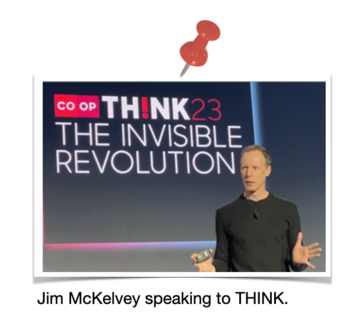
McKelvey had a fascinating story of how Square was able to fend off Amazon, which had sought to enter the same space, and the lesson that he learned. The big takeaway, he told a credit union movement that seemingly every day wants to push Ed Filene off his pedestal and replace him with the word “innovation”—had to do with innovating. In short, advised McKelvey, don’t innovate unless you have to.
Instead, credit unions would be wise to do what they were always told in school not to do: copy others.
“Copying is good. Copying works. Copying is the thing you probably should do most of the time. If you have a solution, great, but if you don’t, find someone who does and copy what they did. That’s smart,” McKelvey said.
You can read more here.
This Was Never in Any CU’s Planning Meeting
Btw, McKelvey, summed up how technology has changed things with this observation: “My iPhone was a chessboard this morning, will be a TV tonight, it’s a map, it’s a flashlight, and sometimes it’s a phone.”
The Other Appeal of Credit Unions
In remarks to the Cooperative Credit Union Association’s CU Accelerate Conference in New Castle, N.H., sales strategist, leadership expert and author Meridith Elliott Powell observed, “I work with credit unions. One of the big challenges you have is people don’t like to change. People in other industries run to credit unions because they hear you don’t want to change.”
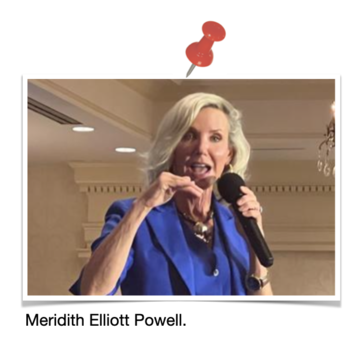
Later, Elliott Powell told the meeting, “A long time ago I heard someone say people don’t change financial institutions, because they believe the experience will be just as bad at other financial institutions. I saw an opportunity. If we just don’t suck, we can grow. If I could talk to your members I bet I would hear all about what it going on in financial services. It isn’t product and services that you are selling, it’s that you understand the pain point of the member or potential member and how you solve that problem.”
The Turn of a Phrase
It isn’t often you hear the turn of a phrase or a metaphor you haven’t heard beaten like a dead horse, a thousand times before, why if you had a dollar for every time you heard it…
And yet Elliott-Powell has coined a description that was new (at least to me) or how to manage a team, establish priorities and create efficiencies.
“…You have to get your team productive and not busy,” Elliott Powell observed. “This is about looking to the past and asking three questions. What are our seeds--what have we done in the last three months that really grew our credit union? What are the weeds on which we wasted our time? And what are our needs--what do we need to do that we’re not doing? It positions the team to be productive and efficient rather than busy.”
Where is the Ghost Supposed to Hide?
The Cooperative Credit Union Association recently held its CU Accelerate meeting at the charming, historic and postcard-worthy Wentworth Hotel on the coast in Portsmouth, N.H.
When I checked in I experienced a first—a hotel room without a closet or an armoire or basically, anywhere for any hanging clothes. Just a six-inch wide nook in which there was a hotel robe.

After double-checking to ensure I wasn’t missing the obvious, I headed to the front desk to explain the situation and ask for some hangers. One front-desk clerk was surprised and said she had never heard there were rooms with no closets, before a bellman who was standing nearby added nonchalantly, “Yeah, the rooms on the ends don’t have closets.”
Back in my room and armed with hangers, I used wall sconces and the telescoping make-up mirror in the bathroom to hang up items and give the appearance of someone who had just been through a flood.
The next day I discovered from a woman who was an attendee at the meeting that I was not alone, and she had been forced to get equally creative.
‘Don’t Give a Bleep’
During a Q&A with CCUA CEO Ron McLean, NCUA Chairman Todd Harper shared a story he recently heard as part of a podcast during which consumer financial protection was discussed.
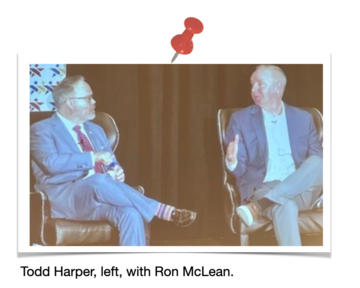
“The podcast host recounted the story from when he was a problem case officer at the NCUA and he was in a meeting in which the director of special actions at the time addressed the team about consumer financial protection by saying, ‘I don't give a (bleep) about that. Are they making money? That's what I care about’,” Harper related. “That attitude, unfortunately permeated NCUA for more than three decades. But it is wrong. Let me be perfectly clear on this point: safety and soundness and consumer financial protection do not compete with one another. It is not a zero-sum game where only one gains…Consumer compliance is not just a good principle, it's good business.”
That’s Not a Joke
While at the meeting I heard one consultant share a story of working in one credit union that only makes loans to high-quality, A-paper members. He related the story of one person at that credit union joking, “We serve the overserved.”
To his credit, this consultant expressed disappointment in the credit union. “That’s not what we were founded to do,” he said.
The New Location, Location, Location
Speaking to the Kentucky Credit Union League’s Executive Forum in Bowling Green, Ky., Ronny Chapman, SVP-fintech solutions CMFG Ventures, the venture capital arm of what is now TruStage, told his audience it’s important to understand what he called “digital real estate zoning.”
The “homestead,” for example, is the home page.
“You can do what you want here, but one thing that’s very important is that almost everything we do today is on the phone,” Chapman said, emphasizing that the way digital content and functionality is served to the member needs to be optimized for that mobile environment.
Chapman said the real challenge for credit unions lies in what he called “rented real estate.” That’s a reference to digital environments over which credit unions have no control. “We have a long way to go here, but this is where we think we have the most opportunity in getting them back to the credit union when they need a financial service,” he said.
You can read more here.
A Thank You
I would be remiss were I not to say thank you to the fine folks in the Bluegrass for having me as a speaker at their meeting. So, thank you, Kentucky.
A Museum With Two Stories
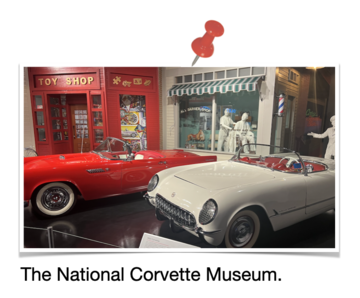
I’m not really much of a car buff, but the Kentucky league’s meeting was held just a few miles from the National Corvette Museum in Bowling Green, Ky. What makes the museum so interesting isn’t just the history of the iconic sports car and the models that are on display, but the museum exhibit on the 2014 collapse of a sinkhole under the its Skydome area, which rests on top of the extensive cave system in that area of Kentucky. The collapse took with it a number of collectible Corvettes, although some survived, including the one-millionth Corvette manufactured.
Today, the museum includes several glass portals that allow visitors to look down at the cave that remains below the museum. You can read more about all of that (and watch security camera footage of the collapse) here.
Frank J. Diekmann is Cooperator in Chief of CUToday.info and can be reached at Frank@CUToday.info. Mr. Diekmann is also author of several new book, including the brand new “The Last Lyric,” a humorous satire about a murder investigation at the Rock & Roll Hall of Fame in which every line of dialogue is either a classic pop/rock song title or lyric. Available on Amazon, Apple iBook, Barnes & Noble and Smashwords. Mr. Diekmann is also author of a non-fiction compilation of the very best & worst he has seen and heard in covering more than 500 CU meetings and conferences, “501 Name Tags: How Everything You Need to Know About Business Can Be Learned at a Conference & Forgotten in the Trade Show.” It is available on Amazon, Barnes & Noble, Apple, Lulu, and Smashwords