

By Frank J. Diekmann
They came, they saw, they lobbied, they ate fried food on toothpicks…

Some highlights, lowlights and lack of light from CUNA’s Governmental Affairs Conference in Washington last week:
It’s Story Telling Time. Again.
If I am struck by one thing each year when CUNA convenes the biggest gathering of credit unions, it’s this: never have so many people come together despite not knowing why they are there or what it is that got them to D.C. in the first place.
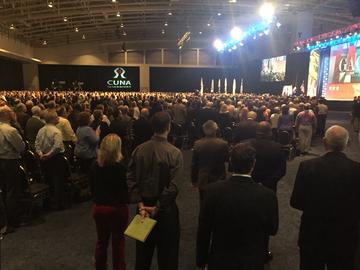
The crowd at CUNA's 2016 GAC.
Before I continue, let me offer some advice: Slowly, but firmly, hang on with both hands to whatever device on which you are reading this. Ready? OK. Apparently, credit unions “need to do a better job of telling their story.” You say you may have heard in passing a mention of something similar?
“We need to let people know of our accomplishments, and how we on a daily basis help improve the lives of our members,” said CUNA’s CEO, Jim Nussle, during GAC. “We need to aggregate and celebrate our successes, not only to policymakers but to the public at large.”
The “inability to tell our story” is the refrain every year at GAC. And NAFCU’s annual meeting. And the league meetings. And, I surmise, even meetings of two CU people bumping into each other on an elevator.
Setting aside for a moment the fact CU membership hit 105 million (or a third of the U.S. population) at year-end 2015, meaning someone is tuning into story time, since everyone seems to believe the story isn’t being told, the next obvious question is what to do about that? Perhaps CUNA ought to ditch one or three of its invited members of Congress because of the risk that their demos of Speaking Much & Saying Little is rubbing off in favor of a GAC session or three on exactly how to better tell that story. What is the story? What’s the best way to illustrate that story? How can you keep it short and powerful and personal?
And where’s the best place to tell that story? Capitol Hill or the state legislatures? I don’t really think so. As I’ve noted here before, in the last eight years I’ve joined two different credit unions, both larger than $500 million in assets (so they have the means for good marketing and training). The number of seconds that were spent telling me the CU story or anything related to why the branch I was in was different from the BofA branch literally across the parking lot? Zero.
Turnabout Fair Play?
CFPB Director Richard Cordray spoke to GAC and did so with a black eye. Cordray joked he got it by being “beat up by CUNA.”
A Marketplace Flipped On Its Head
It’s buyers beware, right? Wrong, says Daniel Pink, who opened CUNA’s GAC with an Ed (Filene) Talk on how dramatically the Internet has changed the entire concept of a capitalist marketplace. Where sellers once had all the information and control, the reversing tsunami of readily available information—think car sales—has flip-flopped the model and it’s now “sellers beware.” All of that has had implications for credit unions, too. You can read more about all of Pink’s message here.
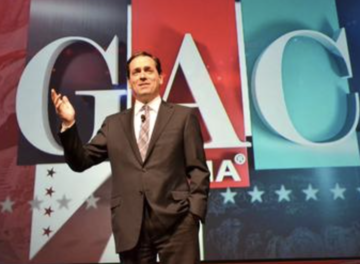
Daniel Pink at GAC.
Beyond that, Pink had several other interesting tidbits and observations picked up over the course of doing research and writing five books. For instance, he noted that in a survey of 7,000 Americans who were asked what picture first comes to mind when asked to think of sales and selling (#1 was a stereotypical car salesman), “not a single person pictured a woman. It was overwhelmingly male association with these very nasty words.”
Speaking of cars, Pink joked that in his neighborhood near DC everyone is required by law to drive a Prius that comes with an NPR sticker already installed.
For credit unions aiming to build the much-discussed “sales culture,” it’s worth noting that some of your very basic assumptions about people who are “good at sales” are probably wrong. Pink said that using a scale of levels of being extroverted, it is people who are at the highest level who are most likely to be hired. But, they are not most likely to lead in sales.
Citing research that surprised many, Pink said while extroverts are almost always considered “naturals” for sales positions and promotions, the data show they only slightly out-perform introverts. A University of Pennsylvania study found that quiet people can be more effective at selling and persuading. The extraverts did a little better in sales. “But the big takeaway from the research is the ‘ambiverts’ crushed the extroverts and introverts,” said Pink. “Which raised the question: What the hell is an ambivert? It’s someone who isn’t strongly one way or the other.”
The Local Flavor
The Homeless Guy Sign of the Week goes to a guy I saw sitting against a wall near the the convention center: “2 Fat to Strip.” He was right.
Meanwhile, I overhead a cashier in the Safeway grocery store near the Washington Convention Center say this to another cashier: “How did I get off? She switched with me. She owes me. I took her drug test for her.”
"The White Paper is Dead”
As CUToday.info reported here, the Filene Research Institute is about to take the last word of its name and make it a verb instead of a noun by instituting more real world applications of its research and work. It’s an issue I’ve heard discussed and debated for some time, which is how to take the work being done by the academics in the tower and apply it to the workers in the field in a way(s) that makes a difference.
The big news is the creation of five “Centers of Excellence,” which will offer deeper, more focused and practical research and direction. The first Center will be the Center for Consumer Decision Making. Plans call for all five centers to be in place by 2017. CUNA Mutual has stepped up to donate $1 million to underwrite the first such Center.
But why the big change? “2008 happened,” said Filene Executive Director Mark Meyer.
In other words, when the economy crashed credit unions didn’t need symposiums; they needed simple, practical strategies to respond. Or stuff that’s been tested in the field and works.
“As we looked at the next three years, it’s all about you,” Meyer told a breakfast meeting during GAC at which the Centers were announced. “We’ve been successful in fundraising, we have 36 research reports a year, and the issues continue to mushroom. So we were very reflective as we addressed the resources we have. And that resulted in three things:
“One, research is alive and well, but the white paper is dying. Our first focus is imaginative experience (videos, podcasts, slide decks, infographics). Two, we need to focus the effort. We have three incubators as three labs. The final piece was looking at all this research and bringing focus by saying ‘no’ to some projects.”
Thinking Again About What McWatters Is Saying
NCUA Board Member Mark McWatters may not be a popular man at agency board meetings, but he has rock star status among credit unions (portions of the audience gave him standing ovations at various times during his remarks at GAC). Still, I did hear one person at GAC say of him, “All he wants to do is merge NCUA into FDIC and turn credit unions into banks.” In the name of full disclosure, let me say I haven’t spoken with Mr. McWatters on that point so that he could respond, but after listening to his address to GAC, I was struck by just the opposite.
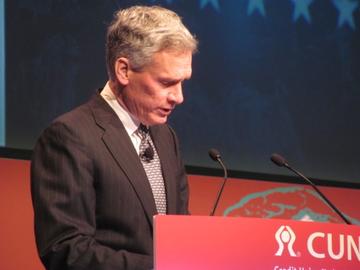
At the meeting McWatters outlined a 21-point plan for regulatory relief (hence the 21-gun salute from credit unions) that you can read more about here. I think critics too easily attempt to stereotype McWatters as just another right-wing Republican more concerned with Wall Street than Main Street and if they took a moment they’d find plenty of Main to go with the Wall.
While listing his 21 points, McWatters observed, “As I have noted during my speaking engagements throughout the country, in an age of burgeoning income inequality, credit unions have a compelling story to tell Congress, the financial services community, and the taxpayers. Remarkably, credit unions have developed business models and plans that specifically target their members, through which they serve the middle class as well as the underserved and otherwise unserved…”
That sounds an awful lot like an endorsement of CUs, not to mention the kind of bipartisan approach so seldom heard in Washington, that the Republican ideal of free markets and limited government (regulation) is the best way to achieve the Democratic ideal of financial equality and opportunity for all.
The Odd & The Inspirational
During GAC, CUNA CEO Jim Nussle again hosted a town hall (along with Chief of Staff/COO Rich Meade) at which credit unions could ask him any questions. You can find additional coverage here. There were two questions from the audience, one odd and one inspirational, that are worth sharing.
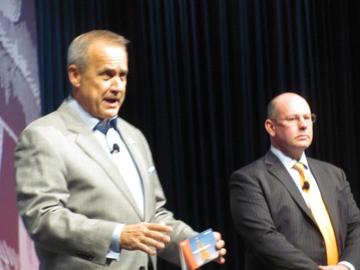
Jim Nussle and Rich Meade at GAC.
In the former, one audience member who seemed pretty angry at the current NCUA board asked Nussle why CUNA isn’t advocating for a seven-person NCUA board instead of the current three so that “two people can’t control it!” A former congressman, Nussle handled that one pretty deftly even I was sitting there thinking, “What? Wait! We’re skipping right past a five-person board?” and “At the rate Congress confirms political appointments, you would have to nominate infants in the hope one might eventually make it.”
The other question—and I apologize for not being able to ID who asked it—had to do with expanding on the concept of the “leave-behind” projects credit unions are leaving at hospitals in Philadelphia and Cleveland this year in conjunction with the political conventions. Why, this person asked, couldn’t credit unions create a “leave-behind” project in Washington every year after GAC?
It’s an intriguing idea, although I do wonder if such a project is more effective in Washington or in the home districts of members of Congress. But if D.C. is the choice, I would think the best project would be something related to the mission and work of credit unions—a big financial literacy day (to which members of Congress could be invited) or even an effort to help refi loans for underserved Washingtonians (there are a lot of underserved people amid all those $350-a-night hotel rooms. Heck, many of those people are probably cleaning them).
You Get the Democracy You Deserve
Another note on the town hall… That session, along an earlier session on CUNA’s proposed bylaws changes to allow “choice,” both offered the kind of democratic input opportunities with their trade associations that everyone always claims they want, and yet both were pretty lightly attended.
Congressman, Our Paperwork is Now Your Fire Hazard
Speaking of leave-behind projects, credit unions once again Hiked the Hill and members of Congress or their staff members all posed for the annual pictures, and then everyone left until doing it all over again next year. If credit unions really wanted to make their point about a chief concern, regulatory overload, then every group should have left behind a printout of every regulation with which they must comply. True, it would mean clear-cutting some national forests for the pulp, but think how noticeable that stack of compliance-demanding paper would be in every congressman’s office.
The Hangover: Credit Union Style
If GAC were a drinking game that involved tossing back a shot every time someone said "You did not cause the financial crisis and shouldn’t have to pay for it,” there would be 4,000 severely hungover credit unionists still staggering to their feet in Washington this week.
Another Mississippian Says, ‘Look in the Mirror’
For the second year in a row, it was a Mississippian who again forced credit unions to look at themselves in the mirror and consider that there might be a few blemishes to be found among all the self congratulation.

Bill Bynum
In this case, the comments came from Bill Bynum, who had led from start up the now very successful, $175-million HOPE Credit Union in Jackson, Miss., and who was recognized with a Herb Wegner Award for Outstanding Individual Achievement. Bynum’s perceptive insights deserved to be heard in front of the full GAC crowd, not just the Wegner dinner audience.
“The greatest risk to our industry isn’t regulatory burden; regulation is not the enemy,” said Bynum. “We’ve seen what lack of regulation has done. Smart regulation is what we need to emphasize. I know it’s the easy battle cry, but it’s the cost of doing business. We have the privilege of being the stewards of other people’s money. I don’t think it’s the regulator who is our greatest risk, or banks lobbying against tax status. Our greatest risk is abandoning our heritage. We put our institutions at greatest risk when we operate like banks in credit union clothing. We put ourselves at risk when we prioritize profits over people. So as we come together tonight I ask that we recommit to our legacy of being financial providers born from the struggle of every day working people. Remember what it is that sets credit union people apart. We are the best and sometimes people’s only hope for economic opportunity.”
You can get the full story here.
Frank J. Diekmann is Cooperator in Chief at CUToday.info and can be reached at Frank@CUToday.info.