

By Frank J. Diekmann

Raise your hand if you enjoy surprises from NCUA. A surprise exam. A surprise “finding” in an exam report. Heck, even a surprise call with birthday well wishes (which only makes you suspicious, right?). And yet the agency delivered a rather pleasant surprise last week in several ways.
Or, perhaps more appropriately, it delivered a trio of surprises in the form of its three board members and what they had to say.
When NCUA hosted its first-ever Diversity, Equity and Inclusion Summit not far from its headquarters in Alexandria, Va.—from which CUToday.info had extensive coverage–what wasn’t a surprise was that the three members of the board were on the agenda. Of course they were. Hey, if you’re working inside the agency as a meeting planner this was one of those perfunctory check-off-the-box requirements for those who want to continue in their federal government careers.
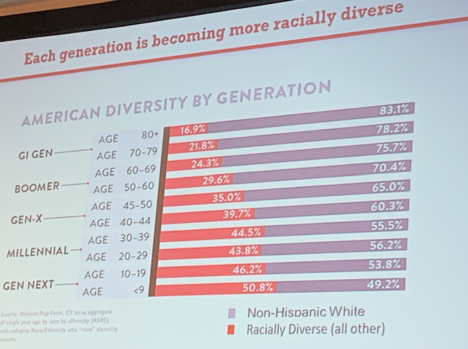
But here’s what made the Summit so much more Summity. All three board members––Chairman Rodney Hood and board members J. Mark McWatters and Todd Harper–could have killed 15 minutes at the podium respectively with some boilerplate about the importance of diversity and inclusion to go with PowerPoints full of charts and graphs highlighting how America’s demographic melting pot is melting in new ways, and then exited the stage to polite applause.
But to their credit, they didn’t arrive looking to check boxes. And while there were more than a dozen unique viewpoints shared during the one-day event, it was Hood, McWatters and Harper who unpacked boxes instead, bringing some of the best perspectives to what’s known as DEI, each in their own way.
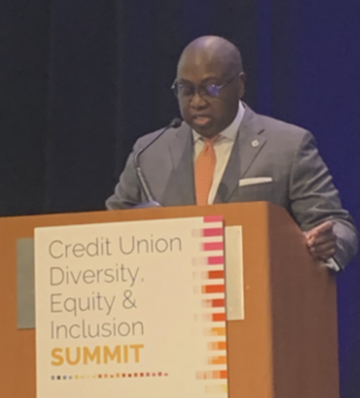
Rodney Hood at DEI Summit.
What Are You Doing in Here?
The first African-American to ever chair NCUA, Hood’s resume includes numerous federal government positions as well as management jobs in the private sector with large institutions. And yet he related how when he shows up early at the conferences and meetings where he is speaking, he often gets questions from hotel staff and others that basically boil down to why is the black guy in the room.
“For me, these discussions of diversity, inclusion, and equity are more than simply abstract ideals — they’re something I believe in deeply and personally, owing to my own background,” said Hood during the Summit. “I’m proud to be the first African-American head of a federal financial regulatory agency. But getting here was not easy, and I’ve worked in the financial services industry long enough to know how challenging it can be for members of under-represented communities.”
Hood said many have also experienced the other side of that same type of bias, such as working for a manager who expectslessof a person because of their skin color, ethnic background or gender.
You can find Hood’s full remarks here.
23andMe. And You. And You and You and You…
The other two board members demonstrated just how diverse the subject of diversity can be. From the outside—which is how bias typically begins—McWatters and Harper were the two white guys, a subject McWatters took head-on by pointing out just how white. He said results from a 23andMe ancestry kit revealed he is 99.6% of Northern and Western European descent.
“I thought, ‘Wow, I’m .4% diverse,” joked McWatters.
But he turned serious in discussing the advantages his ancestry has brought to his career versus others, and not just because of race.
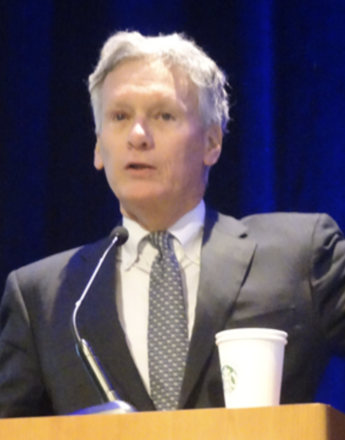
Mark McWatters at DEI Summit.
“During my 40-year legal career, not one time did I have to worry or fret or go home tied up in a knot because of potential backlash or discrimination because I am female,” said McWatters. “Not one time, not for one second, did I have to worry about discrimination or being treated inappropriately because I am a person of color or a member of the LBGTQ community. Or because I had a disability, or I was a member of a non-Christian faith. How many people can say that?”
His goal, said McWatters, is to someday see the advantage disappear for the “99.6% club.”
You can read the full story on McWatters’ comments here.
No Longer Hiding
The final board member to speak to the meeting shared a personal story of his own. Todd Harper shared with the audience his own experiences in not feeling accepted at the beginning of his career.
“I hid who I was,” Harper said. “After all, people lost their jobs simply for being gay. Fortunately, over time, I became more comfortable in my own skin. In doing so, I came out on my own terms and made friends who accepted me for who I am.”
Harper said his own experience illustrates the importance of employee resource groups, which he said can be a valuable resource for employees and employers because they help foster a diverse, inclusive workplace aligned with an organization’s objectives.
You can read more about what Harper had to say here.
Other Notes Worth Your Attention
Some other notes from the DEI Summit that are worth sharing:
Making Day 2 Matter
A member of NCUA’s staff said when the agency initially announced plans for its DEI Summit, it hoped it might draw 50 people. Ultimately, the event drew triple that with 168. That led to talk of adding a second day to the event. But that second day will only be worth it if it’s about doing, not talking. I’m right at the front of the line with Mr. McWatters in noting my own 23andMe results make clear I have not experienced the kinds of bias and real pain you could hear in many of the voices at the DEI Summit. Still, if there is ever a day two at the event it needs to be about creating some actionable plans for attendees to commit to, along with real metrics for measuring whether the job is getting done.
Diverse, But Not Too Diverse
Angela Russell of CUNA Mutual Group had a funny (because it’s true) observation about commitment to diversity, noting, “We want the most straight-acting LGBT person, the most white black person, the most male female…” Russell later recalled that when she—the only African-American VP at CUNA Mutual—joined the company, she was told, “You have to become ‘CUNA Mutualized.’” In brief, she was being told she had to “assimilate,” she related, which raises the question of “How do we see and value differences and get comfortable with them” if people are expected to become like everyone else.
Appreciating Appreciation
Russell also showed a video that highlighted the long-term consequences of mortgage redlining, or essentially keeping minorities out of certain areas. The video noted that many of the homes that were originally for sale in Detroit for $20,000 in the 1960s would later go on to appreciate over time and sell for $320,000, allowing the buyers to build wealth. Buyers in other areas don’t see that kind of appreciation or wealth-building. NCUA’s Mark McWatters pointed out following the video, “Location of the home can be far more important than just the equity in the home.”
Losing the Movement
Observed by Charlotte Ducksworth, the chairman of DC Federal Credit Union, “When credit unions started they were a model many were not willing to accept. If we don’t go into the next phase of shaking the foundation of what we see, then we have lost the very movement we came out of.” Later she added that when it comes to a credit union’s own efforts to meet the needs of a diverse membership, “You can’t tell people what they need, they have to tell you.”
A Board Failure
The story of one credit union’s failed effort to bring diversity to its board was shared by one attendee. The board, described as “too white, too old, too bald and too male,” finally opted to add to its ranks a young mother who was also Latina. She didn’t last long. “She had a different opinion; she lost a lot of 6-1 votes,” the attendee shared. “And board meetings were at 3:00 on Tuesdays. What is your strategy when someone who comes in thinks differently? We wait for assimilation. They aren’t about checking a diversity box for you, they need to be truly valued.”
That’s Not an Invitation
Observed another person, “Saying ‘we are open to all’ doesn’t invite people to the table.”
Another Hidden Cost
Several attendees and speakers talked about how many people excluded from the basics of finance pay a price throughout their lives. In many communities it was noted how there are no mentors on how to buy a home, go to college, or open a checking account. It’s a cycle that keeps repeating. “All that comes at a cost to many people who are excluded from the mainstream economy,” said one person.
Words Matter. Sometimes Too Much
During a discussion on the metrics that should be used in measuring the success of diversity and inclusion efforts, Victor Corro of Coopera said, “Sometimes, collecting the data is difficult because this conversation brings up the differences between us. Sometimes people shut down. I see it in my consulting work where we work with a lot of boards. We worry about how we’re being perceived when we say certain words. Let’s mind the language a little bit less and build goals around being more inclusive.”
The Examiner’s Words
It may have been during a meeting hosted by NCUA, but during that same discussion around metrics Cathie Mahon of Inclusiv said when it comes to DEI, “There is a concern as always about the extent to which the regulator is truly going to value the business model. We do have to be clear that a lot of our diversity resides in credit unions that are being told every time they are examined that their business model is not sustainable. The examiner says, ‘I have a list of other credit unions you need to start thinking about merging into.’ There are a lot of institutions that may not transition to the future, but there are also a lot that represent sustainable business models.”
Frank J. Diekmann is Cooperator in Chief at CUToday.info and can be reached at Frank@CUToday.infoor @FrankCUToday.