

By Frank J. Diekmann

Here’s a reminder that you never know what kind of surprises you might discover when exploring your family’s history…
After I had been covering credit unions for approximately 20 years as a reporter and editor, my father casually mentioned one day that he had served on a credit union’s board at one point during his career. Why he felt I needed two decades to prepare myself to handle this news, he never mentioned.
It wasn’t something he ever really brought up again; he never said much of anything about credit unions at all. All I ever knew was the credit union was in the Cincinnati area.
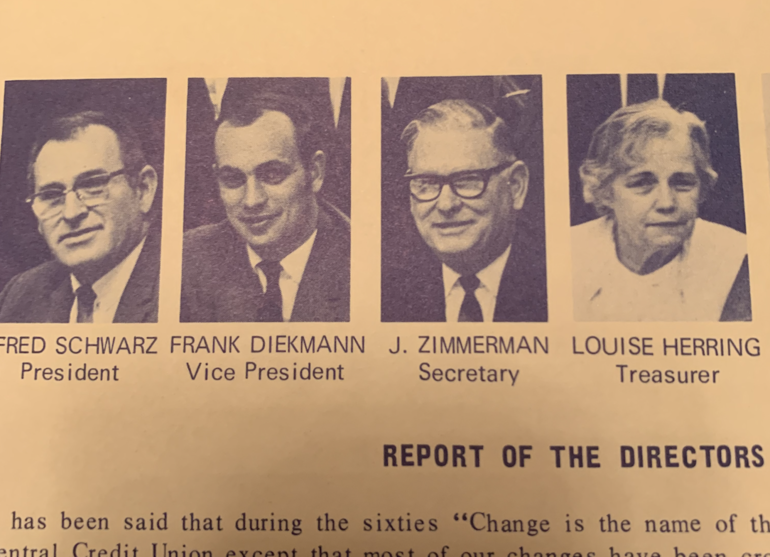
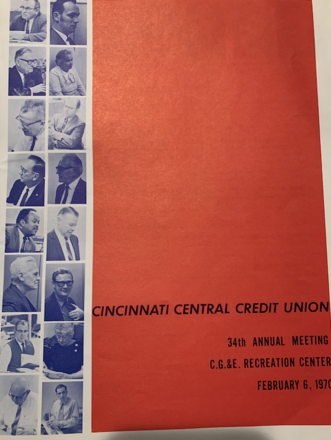
Then, last week, while going through some old files and clippings with my mother, she pulled out the annual report of Cincinnati Central Credit Union, dated Feb. 6, 1970. And there were pictured the members of the board, including my dad (he’s also a Frank, as I am the fifth one in a row in an otherwise not particularly creative Diekmann family), as vice president of the board. And who is that pictured to the right? None other than fellow board member Louise Herring, the Ohio CU pioneer nicknamed the “mother of credit unions,” who helped charter 500 CUs and who was on hand in 1934 when CUNA was formed in Estes Park, Colo. You know her, of course, for the Louise Herring Award for Philosophy in Action presented by CUNA and its state leagues each year.
Seeing it felt a bit like one of those Ancestry.com stories of finding you’re a distant cousin to someone famous. When I explained to my dad that there are now annual national awards presented in Louise Herring’s name, I had been holding out for some good stories, like someone who had been on hand in Philadelphia when the Constitution was being written and who had the inside tales of what Jefferson and Adams were really like. But no such scoop. All he remembered was that she was on the board.
Another Connection
But that wasn’t the only Herring connection. In the Cincinnati Central CU annual report there is a list of 13 numbered items representing the highlights of 1969. Number 10 reads this way: “Appointed a young college graduate, Bill Herring, as manager. He has brought enthusiasm and dedication to the management of the credit union.”
Bill was, of course, Louise Herring’s son, and for many years was well-known to many in credit unions in Ohio and nationally for his work. Bill was joined by his sister, Catherine, in following the call of the co-ops, and in 2015 the credit union at which Bill was CEO, the same Cincinnati Central, merged with the credit union that was led by Catherine Herring, Communicating Arts, to create TruPartner Credit Union. Both Herrings have since retired and were honored for their contributions during CUNA’s GAC in 2015.
I spoke often to Bill when he was still in credit unions, and in one of those strange circle-of-life coincidences (that some will no doubt read way too much into), I wrote about their retirements here.
Other Points of Interest
A couple of other observations from that Cincinnati Central newsletter of 50 years ago:
The Only Thing Constant Is…
It’s not officially a credit union meeting or webinar in 2021 unless someone very smart reminds us about the “speed of change.” Credit unions talk about change more often than coin-counting machine salesmen and make it sound as if it’s something new.
So it was interesting to read this in the “Report to the Directors” portion of the newsletter:
“It has been said that during the sixties ‘Change is the name of the game.’ That is true of Cincinnati Central Credit Union…”
And it was true in the 70s, 80s, 90, 00s, 10s, 20s…
An Asset Threshold
Cincinnati Central was proud to report it bypassed $1 million in assets at year-end 1969. This was before my time, but I was once told CUs of $1 million-plus were known at one point as members of the “Cadillac Club.” Today, credit unions of a million bucks are members of the Pontiac Club, discontinued and hanging on with used parts, some spit and a lotta love.
Sounds Pretty Good Today
CCCU reported that in the year prior it paid a 5.25% dividend rate on shares. On the other side of the ledger, it increased its maximum “insured loan” to $10,000 from $5,000. It also paid an interest rebate of 5%.
The Main Frame
Not just proud of its assets, Cincinnati Central also reported, “Converted our record-keeping to data processing and secured the management tools of the computer.” Imagine all the state-of-the-art punch cards that were in CCCU’s future at the time.
The Central Message
As the name implies, CCCU was a “central” credit union, operating at a time when CUs that served other CUs in addition to members were called “centrals.” The annual report notes that in 1969 it expanded service to 12 “corporate members.”
Some Things (Shouldn’t) Change
While most things change, the best things don’t—or at least shouldn’t. This was the last paragraph of the Cincinnati Central 1969 annual report to the membership:
“Although many things have changed, our basic reason for organizing the credit union has not changed. We are dedicated to provide (sic) a safe and convenient place for members to save and to pay a fair return on those savings, and to provide a source of credit at the lowest possible cost. We are pledged to assist the Cincinnati Chapter, our parent organization, to increase credit union service to all people in our community. We invite you to tell us how we can better accomplish these objectives.”

And for that, the credit union should have gotten a Louise Herring Award.
Frank J. Diekmann is Cooperator in Chief of CUToday.info and can be reached at Frank@CUToday.info. Mr. Diekmann is also author of the new book, ‘501 Name Tags: Everything You Need to Know About Business Can be Learned at a Conference & Forgotten in the Trade Show.” For info: www.501nametags.com.