

By Mike Brown
For decades, we have watched as the cost of college in the United States increased at a pace that has been three times faster than the inflation rate. In 2020, you can expect to pay anywhere from $40,000 to $50,000 for a single year at the average American college or university.
But, for how much longer is that going to last?
While we largely sat silent as the cost of higher education grew and the student loan debt bubble ballooned to a staggering $1.64 trillion, it did appear that the connected issues had finally garnered the attention they deserved in the last few years.
Even still, the can likely would have continued to get kicked down the long, bumbling road of American democracy for at least a few more years before any real progress was made.
However, a crisis has a unique way of exposing deep, structural issues in a society more quickly than some would like. In this case, the “some” are colleges and universities throughout the country, while the crisis, of course, is the global coronavirus pandemic.
Brought to Life
The COVID-19 outbreak that has riddled the entire world with unimaginable devastation quickly brought to light the gross manner in which we have overvalued and overpaid for higher education in the U.S.
When college campuses necessarily shut down in mid-March and students were sent home to finish off the semester in online Zoom classes, higher education was stripped bare and made plain to see. Parents, the ones who are oftentimes footing the bill, saw what really went into earning a degree when you take away the gorgeous campuses, the libraries, and the state-of-the-art dining halls and gyms.
Credits were earned with just a few virtual chatroom sessions and the question that was being asked in every American household was, “THIS is what I’m paying $50,000 a year for?”
The coronavirus pandemic will forever change the higher education system in this country, and the student loan market could shrink significantly as a result.
Weighing Alternatives
LendEDU, a financial services company, recently published the results of a survey of 1,000 current high school seniors from the class of 2020 and current college students from the class of 2021 or later.
LendEDU’s report sought to gauge the impact the coronavirus pandemic will have on the future of higher education. For example, the study found 30% of current high school seniors that have already committed and sent a deposit to a college would try deferring their admission or consider not enrolling if virtual learning continues into the Fall 2020 semester.
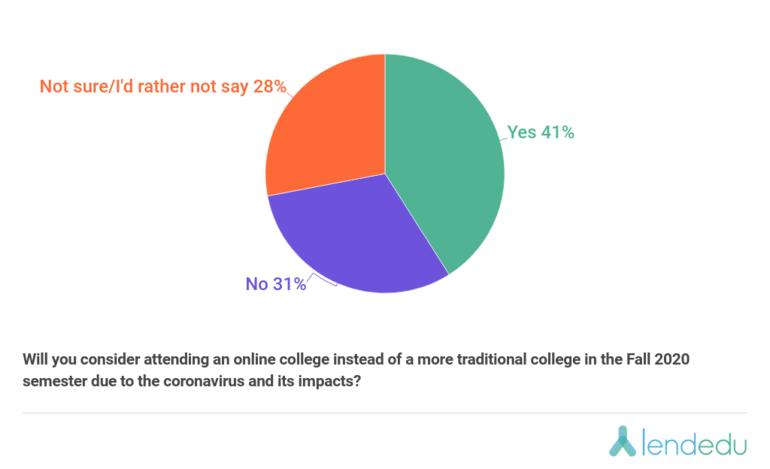
The study from LendEDU also found 41% of current high school seniors that are undecided are considering online college as an alternative next Fall, while 37% are weighing community college, and 43% may just take the entire year off.
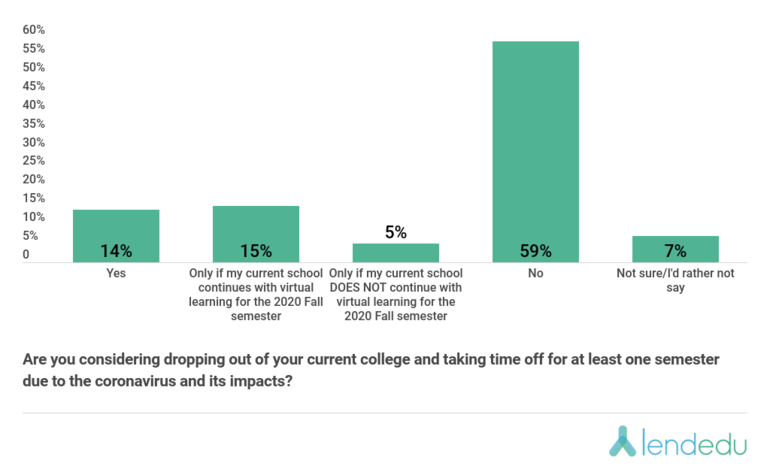
When it came to current college students, the survey from LendEDU found that 40% are considering transferring to a more affordable college or one closer to home, 34% are considering dropping out and taking time off, 28% are considering dropping out and enrolling in an online college, and 26% are considering dropping out and enrolling in community college for the Fall 2020 semester.
It appears that colleges are staring down a long-awaited reckoning, but still sooner than they expected. The University of Michigan is already projecting 2020 revenue losses of up to $1 billion due to an anticipated drop in demand, while other experts are predicting countless institutions closing for good in the coming years.
And while the student loan industry has grown into quite the big business, it could be looking at a contraction over the next couple of years as college demand drops and tuition prices lower.
Potential For a Major Hit
One of the biggest benefactors of the rising cost of higher education has been the student loan industry. Not only have federal student loan servicers prospered, but there has been enough room to allow private student loan lenders to thrive, and even credit unions that offer their own student loans.
But, the party might be coming to an end. As evident from the data above, the demand for traditional higher education will drop in the coming years as more flexible options like online college or trade schools become more viable alternatives.
Not only will this lack of demand shrink the student loan market by itself, but it will force the colleges that survive to reduce their tuition prices to remain competitive. This, in turn, will drastically reduce the need amongst student loan borrowers to take on six-figure debt loads.
Instead, the future cost of college will only require a couple of federal student loans for most students. But, who’s to say that a large percentage of American families might not be able to afford the total cost out of their own pockets in the coming years? It’s certainly possible, especially when you factor in scholarships and grant money.
And after that, what’s left is small scraps that will get picked up by the few surviving private student loan lenders or the credit unions that wish to remain in the higher education lending business that suddenly isn’t looking too hot.
Mike Brown is director of communications with LendEDU.