

By Frank J. Diekmann
At first glance, the old cliché about the tail wagging the dog comes to mind, and yet, somehow that just doesn’t really quite sufficient. It feels more like a flea on the tail shaking the dog.

But you know, that doesn’t really seem adequate, either. And that’s because I suspect it’s not about the dog at all.
The dog in this case is named NCUA, and the shaking has to do with last week’s 2-1 board vote to delay the risk-based capital (RBC) plan until Jan. 1, 2022. The rule has been delayed so many times it’s moving into Predictions of the Cashless Society territory, where time is measured in epochs. A proposal that actually goes all the way back to 2000 (remember Y2K?), it was first formally proposed at NCUA in 2014 (remember All About the Bass by Meghan Trainor?) in response to the Great Recession. It was formally approved by the board in 2015, with an effective date of January of 2018. Then January 2019. Then 2020. And now 2022.
According to the National Bureau of Economic Research, the Great Recession officially ended in June of 2009. If the January 2022 effective date holds, and I wouldn’t bet your credit union’s capital on it, it will go into effect a full 13 years after the dogs of the recession bit so many people long and hard and motivated the rule in the first place.
Even the Glaciers Noticed
It’s been around so long NCUA Board Member J. Mark McWatters has been able to vote on it three times. It’s been around so long other federal regulatory agencies, such as the FDIC, will be reviewingtheir rules before NCUA ever enacts its own. Indeed, NCUA Board Member Todd Harper, who was the 1 in that 2-1 vote, repeatedly pointed out NCUA is the only federal regulator to not have enacted rules that take risk into account, and it already trails its D.C. counterparts in doing so by a decade. When you lag any federal regulator in getting anything accomplished, even glaciers start throwing shade your way.
Many of you will you will respond that delays in federal rules are a great thing.
Must-See TV
If you weren’t on hand or didn’t watch the livestream of the NCUA board meeting at its headquarters, you missed out on Must See TV. Harper’s grilling cross-examination of NCUA staff on this issue was something worthy of a great courtroom drama, peppering Director of Examination and Insurance Larry Fazio with hard questions to which Harper already had the answers, and all designed to make the defendant, sorry, Fazio, all but take a plea deal as he was forced to confront earlier testimony before a different NCUA board that seemed to be the opposite of what he was now saying.
Not Testifying
Although he was sitting just a few feet away, left off the witness stand was McWatters, who is an attorney, or surely his fellow board member Harper would have put him in the box and asked about this statement McWatters made when he was chairman in 2018 and voted in favor of the 2020 effective date for the RBC rules: “The proposed changes to the risk-based capital rule, reached through a collaborative and bi-partisan process, if finalized, would allow the agency to provide federally insured credit unions with a measure of regulatory relief without impairing the safety and soundness of the National Credit Union Share Insurance Fund.”
Now, less than a year later, that old dog has a new name: Impairment.
As Harper stated and then Fazio confirmed, the NCUA risk-based capital proposal exempts 90% of credit unions (no banks are exempt from the FDIC’s or OCC’s rules); just 257 “complex” CUs are affected (of which just four would see a decline in their PCA category); just three credit unions are currently considered critically undercapitalized under the risk-based net worth standard; just one“complex” CU in the U.S. currently fails the standard, and the risk ratio of complex credit unions actually rose by 20 basis points last year. All that adds up to the flea shaking the dog.
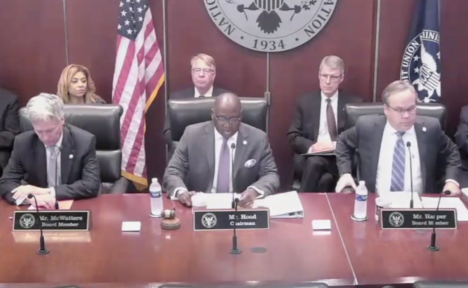
The NCUA Board meets on June 21. From left, J. Mark McWatters, Rodney Hood and Todd Harper.
You can read excerpts of Harper’s near hour-long cross examination here.
Groundhog Day
Near the end of his remarks, even though the vote’s outcome was already in the bag, Harper remarked, “In terms of this risk-based capital effort, we are forgetting the past repeatedly, like the characters in Groundhog Day.”
But unlike Groundhog Day, where Bill Murray’s Phil Connors gets the girl in the end, it doesn’t appear there’s any end in sight.
Former NCUA Board Chairman Dennis Dollar had a very good observation in a story on CUToday.info you can find here.
Pointing to what he called the “ebb and flow” of regulatory actions, Dollar noted, "Chairman (Norman) D’Amours passed the Community Action Program as a type of CRA for credit unions until the Dollar administration reversed it before it went into effect. The Dollar administration passed and implemented RegFlex until the Matz administration undid it. The Matz administration was totally in on RBC as absolutely essential in their view, but now the McWatters and Hood administrations are essentially delaying it into a timeline that will make it difficult to implement with any real impact. This action basically assures that, if RBC is ever to become a final and implemented regulation, it will have to be started from scratch with supplemental capital included and a more credit union by credit union approach than the current one-size-fits-all risk weighting categories. There will always be future boards with future priorities dealing with future circumstances.”
That is a spot-on perspective. Indeed, depending on the next election, Harper could actually be appointed chairman and would be able to put the RBC proposal back on the agenda. As it stands,
if the Jan. 1, 2022 date remains in effect, only Hood will still be on the board. McWatters’ term expires later this year, while Harper’s term is to expire in April of 2021.
The Real Dog in This Fight

President Trump with NCUA Chairman Rodney Hood.
But for now, none of that is the real dog in this fight, because none of this is about risk-based capital. What this is really about is a capital of a different type and the administration running it.
Several weeks ago NCUA distributed a photo of Chairman Hood as he met with and played golf with President Trump at one of the president’s golf resorts. You’re not in the president’s foursome unless 1) you’re willing to finish at least second on the scorecard, and 2) you’re completely on board with the regulatory agenda, as in no new regulations (the RBC delay was the only item on the board’s agenda).
Forget any new threats or the risk from a new recession, or as Hood described it, the need for a “holistic” review of the rule—this is all about an old DC dog named politics.
The Pendulum Swings
So who knows how this dog show will ultimately turn out? In the meantime, here’s to hoping the economy remains healthy enough that there will never be any need to give the hindsight analysis of Mr. Hood’s and Mr. McWatters’ decision, or to find out if the risk-based capital standards will need to be put to the test. The CBO has published an analysis suggested the lack of risk-based capital standards in credit unions could be seriously costly to the share insurance fund over the next decade.
Let’s just hope this is a decision that doesn’t come back to bite.
Frank J. Diekmann is Cooperator in Chief at CUToday.info and can be reached at Frank@CUToday.infoor @FrankCUToday.