

By Frank J. Diekmann

It appears there’s a new driver of mergers and consolidation peeking over the horizon in Credit Union Land, although it’s so new it’s likely few have given it much thought.
And in this case it’s yet another example of the ironies we often don’t recognize taking place even when right in front of us.
If you’ve been watching the daily reporting in CUToday.info then you are aware Alliant Credit Union in Chicago has announced it plans to eliminate its overdraft fees. That news followed by just a few weeks an announcement by University of Wisconsin Credit Union that is it cutting its overdraft fee to five bucks.
“We think this is the right thing to do by our members,” Alliant CEO Dennis Devine said in an interview with CNN. “And this puts pressure on the rest of the market to do the right thing.”
And therein lies some of the irony. Cutting or eliminating overdraft fees, long a target of consumer groups and some in Congress, may indeed be the right thing to do for members, but in the long term it’s also likely to cost some (many?) members their credit unions.
It isn’t the elimination of the NSF fee alone that will toll the bell for some credit unions; rather, it will be yet another pull on the rope. And you can only have your bell rung so many times before you’re knocked out. It’s an issue on which I’ve written countless times deserves more attention from the trade groups, in my opinion.
The Disparity
I’m not going to dedicate many sentences to the performance differences between large and small credit unions;

CUToday.info has provided extensive coverage of the issue, most recently with CUNA Mutual pointing out in its Trends Report, “The disparity between small and large credit unions’ return-on-asset ratios increased significantly over the last year.”
If you aren’t sure which way that ROA disparity is leaning I should probably use this opportunity to let you in on the news there’s a certain virus going around.
Scale is the biggest reason behind mergers. It’s directly or indirectly cited in nearly every deal that is announced. Alliant Credit Union has $14 billion in assets; UWCU $4.6 billion. They have the kind of scale needed to take a hit on non-interest income such as eliminating overdraft fees. Many smaller credit unions simply do not, even when they very much would like to do so because it’s in the best interest of members.
As Mr. Devine observed above, “This puts pressure on the rest of the market to do the right thing.”
It does indeed create pressure. Pressure on other large CUs to make a similar move. Pressure on banks to do the same. And pressure on what really defines “the right thing.”
And Speaking of Numbers…
It isn’t just ROA that’s a Tale of Two Metrics. Newly released data from NCUA show that while overall membership in federally insured credit unions continued to grow during the year ending in the first quarter of 2021, 55% of federally insured credit unions had fewer members at the end of Q1 than a year earlier.
Although asset growth was strongest in Idaho and Nevada, in 28 states and Washington, D.C., the median membership growth rate for federally insured credit unions was negative, NCUA reported.
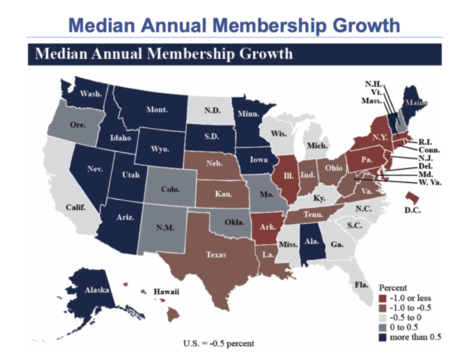
That data was reported even as overall, federally insured credit unions continued to experience double digit asset and share-and-deposit growth over the year ending in the first quarter of 2021, with a slight decline in lending over the same time period and with fewer CUs reporting positive net income.
The data was included in NCUA’s new Quarterly U.S. Map Review, which shows that nationally, median asset growth for federally insured credit unions over the year ending in the first quarter of 2021 was 17.1%, compared with growth of 3.0% during the same period a year earlier.
You can find the full report here.
Hey, CUs, Where Do You Stand?
I was speaking with someone last week who works in credit unions and is part of a coalition of consumer groups in her community and who asked to remain anonymous. The reason: she related how many of those groups are frustrated with credit unions and she is often just as frustrated in not knowing how to respond to them.
For years credit unions and consumer groups walked lockstep with each other, aligned on nearly every issue. But that has changed over the past decade as credit unions have gotten larger and have taken some positions that are at odds with the consumer groups.
The most recent example is credit union opposition to a bill in Congress that would cap interest rates at 36%, a lid already in place on loans to members of the military. Consumer groups have advocated in favor of the bill.
The woman with whom I spoke shared how one person representing a consumer group had remarked, “If credit unions can’t stand with our consumers, then you are in bed with high-cost lenders.”
The credit union community, obviously, would push back pretty hard on that accusation, given how CUs offer PALs as alternatives to triple-digit loans from payday lenders and the like, how they often help refinance members out of debt traps, and more.
Losing an Ally?
But what may matter most here is just the perception by a long-time ally that credit unions have departed from their roots of helping people.

With the CU tax exemption always in the cross-hairs of the banking lobby, the movement may have a challenge if it ever needs allies to stand with it in the future, and suddenly finds itself standing alone.
I recently spoke with NAFCU’s chief economist, Curt Long, about what some groups misunderstand about the opposition to the 36% rate cap, which you can read more about here.
Frank J. Diekmann is Cooperator in Chief of CUToday.info and can be reached at Frank@CUToday.info. Mr. Diekmann is also author of a brand new book, “The Last Lyric,” a humorous satire about a murder investigation at the Rock & Roll Hall of Fame in which every line of dialogue is either a classic pop/rock song title or lyric. Available on Amazon, Apple iBook, Barnes & Noble and Smashwords.