By Frank J. Diekmann

Here is another collection of odds and ends from the Reporter’s Notebook...
Maybe a Little Irrelevancy Wouldn’t Hurt
Credit unions frequently talk about the imperative of being relevant in members’ lives and of raising their profiles, both in their communities and even nationally. To that end we’ve seen all manner of high-profile marketing initiatives and naming rights deals with sporting events and arenas and the like.
But all that attention can also draw the wrong kinds of people, one person recently reminded.
Speaking to the NACUSO Network meeting in Orlando during a special session called Transformation Thursday that was hosted in part by Mitchell Stankovic & Associates, Sam Das of TruStage Ventures, observed, “We are in the middle of a cybersecurity and AI arms race. Digital fraud has been with us since the beginning of the Internet and bad actors have been using old methods and refining them using new methods every day, including high-tech like botnets, brute force attacks, and credential stuffing. They're automating these now with AI and machine learning so that they can conduct literally thousands of attacks every hour.
“That's all very scary, but the good news is the same technology can be used to fight back. It brings us back to the heart of the question of this panel. For every credit union and CUSO this is a double-edged sword. The more relevant we become to credit union members, the more at risk we are for these type of attacks.”
You can read more about what was a very insightful panel discussion here.
Employers Need to Employ Some New Thinking
During that same “Transformation Thursday” event, part of Mitchell Stankovic’s “Underground” series of meeting, was another insightful panelon how the world of recruiting and retaining talent is changing.
The panelists included Jill Nowacki, president of Humanidei; Heather McKissick, CEO of CUES, and Renee Sattiewhite, CEO of the African
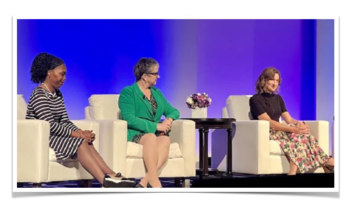
American Credit Union Coalition.
Among their observations:
- “Your organizational culture will never be better than your most toxic employee.” –Jill Nowacki
- “One of the things I'm challenging (employees) to be is to not be unreasonable with themselves about kindness. I believe when people are kinder you get so much more done. So, I'm telling leaders to make sure that you're being kind, make sure being respectful. Those things matter.” –Renee Sattiewhite
- “We talked a lot about resilience and I've been talking a lot about resilience myself lately. I'm starting to even shift that thinking to think less about resilience in terms of bouncing back to thinking more about this idea of needing to be elastic leaders. I think that that's the idea around real emotional intelligence, that we can we can expand or shrink to fit the appropriate situation based on our and our organizations. That’s really all about change management.”–Heather McKissick
Alone on the Range
CUToday.info provides the most extensive coverage of what’s happening in mergers in credit unions of any publication, including reviewing every member disclosure statement filed with NCUA.
As I’ve observed before, while there is much that should bother the collective cooperative conscious of credit unions in many of those disclosures—including what feels like more and more insiders just blatantly cashing in on the members’ capital—some of those forms also represent historical markers along the Credit Union Road. Signs that won’t be seen again.
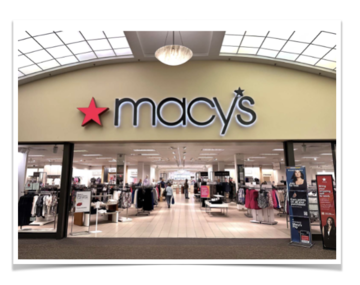
The latest example drawn from our reporting, which you can find here and here, is from MM Employees FCU, The first M stands for Macy’s, the venerable department store, and the second for Montana. The credit union was chartered to serve—and it never expanded—employees of the lone store in the state, in this case in Bozeman.
In explaining to members why it needed to merge, MMEFCU pointed to its “inability to grow,” combined with the retirement of its manager of 47 years—nearly a half century!—and the fact it can’t find board members.
At the time it announced its last clearance sale, MMEFCU had just 344 members. Interestingly, given the era, it was chartered in 1937.
Former CEO Shares a Cautionary Note
I was speaking recently with the retired CEO of a credit union in the Northeast. Among the last things this CEO had done was join with his board in negotiating a merger in which his CU would be acquired by another in the area.

As part of the agreement, the acquiring credit union had committed to adding two board members from the CU being merged out to its own board, as well as a similar arrangement for the supervisory committee. Those deals were to last three years.
Following the merger the deal was honored until something occurred that this CEO’s credit union had not anticipated: One of the volunteers from the former CU had become ill and could no longer fill out the full term. Rather than replace him, his seat went unfilled and, even though it hasn’t been three years since the merger, it is to remain empty.
The former CEO just wanted to urge other credit unions, should they negotiate such a deal, to consider these kinds of contingencies.
If You Want Your Brainstorming Session to Excel, Then Don’t Use It
Admit it. Somewhere in your credit union or organization there is a whiteboard. And if not a whiteboard, an easel to hold that oversized pad of paper on which you write down all the ideas thrown out during that brainstorming session at which someone will invariably announce, “Don’t be afraid. No idea is a dumb idea!” (And then you find yourself thinking—and likely more than once--“That’s a dumb idea.”)
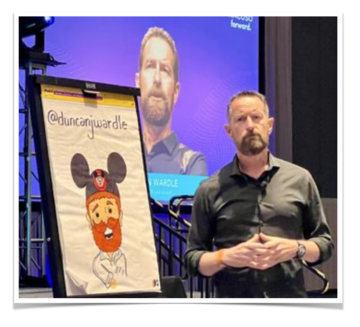
But most brainstorming sessions are destined to be little more than a light drizzle because when it comes to thinking about creativity, it’s important to first really understand all that stands in the way and then doing something about it, according to Duncan Wardle, who spent 25 years at Walt Disney Co. where he was head of innovation and creativity.
Wardle recently shared with credit unions that there are three different ways people learn, which means that “two-thirds of your room do not share your learning style. It’s death by Excel. You lose one third of the room when you put an Excel up on the wall.”
Unfortunately, You Know the Drill
He shared his experience in consulting with leaders at Black & Decker during which he pitched to them that their brand is really about “people building their dreams.” The pitch was rejected by company execs who said, “No, we make tools.”
Wardle attempted to counter by pointing out in 20 years people will be using 3:D printers on projects, and hammers and chisels will be found in the Smithsonian. Still, no sale on his vision about building dreams, he said.
“Are you in the credit union business, or are you in the experience business?” asked Wardle. “Are you dream builders? How might asking that change what you do?”
You can read more of Mr. Wardle’s insights here. https://www.cutoday.info/THE-feature/How-to-Really-Develop-the-Creativity-Habit
Check Now, Learn Later
At a recent CU event a credit union in Michigan said it looked at its member data and discovered that out of 60,000 accounts, there were 15,000 buy now, pay later transactions. That means there were 15,000 transactions for which members looked to another provider.
That Michigan credit union isn’t alone.
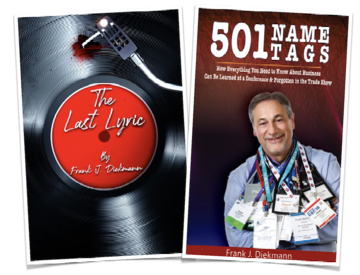
Frank J. Diekmann is Cooperator in Chief of CUToday.info and can be reached at Frank@CUToday.info. Mr. Diekmann is also author of several new book, including the brand new “The Last Lyric,” a humorous satire about a murder investigation at the Rock & Roll Hall of Fame in which every line of dialogue is either a classic pop/rock song title or lyric. Available on Amazon, Apple iBook, Barnes & Noble and Smashwords. Mr. Diekmann is also author of a non-fiction compilation of the very best & worst he has seen and heard in covering more than 500 CU meetings and conferences, “501 Name Tags: How Everything You Need to Know About Business Can Be Learned at a Conference & Forgotten in the Trade Show.” It is available on Amazon, Barnes & Noble, Apple, Lulu, and Smashwords.