

By Frank J. Diekmann
You might not know it from the ostentatious displays, the blatant consumerism, and the Facebook boast-posts that brag “look what I have that you don’t,” but it is humility that is supposed to be at the heart of the holiday season that is bookended by Thanksgiving and Christmas.

So it’s in that spirit I share the stories of two people working in credit unions that you’ve likely never heard of doing work in places you have also likely never visited. Their work and accomplishments will almost certainly leave you humbled. They did me.
Earlier this summer I had the privilege of being a judge in the Joe Biden Awards for the Development Educator of the Year from Africa, Asia, Australasia, the Caribbean and Europe (it might be easier to simply rename this “DE of the Year from Outside North America”), which are presented by the London-based International Credit Union Leadership Development and Education Foundation. And that’s where I learned of Ann Mbaabu and Debbie Say. Their stories are unsung, so let’s sing a little.
Mbaabu is the branch manager of Stima Sacco Society (credit union) in Mombasa, Kenya. Consider this from Ms. Mbaabu, 32, who shared her background:
“I come from a Bantu community in Kenya known as Ameru, which is that of my late father. In Kenya, the child belongs to the clan of the father. My mother is from a Bantu community known as Agikuyu. The interesting bit about our Ameru culture is that when a man marries a Meru woman, she comes with a 10-year guarantee; there is no divorce allowed until after the tenth year of marriage, as one risks being summoned by the Anjuri Njeke who are the clan’s men or elders and of being disowned by their family. I suppose that’s why Meru ladies are on high demand, they can put up with so much and persevere…”
And you thought you overcame an obstacle because your high school didn’t have a Starbucks…
'Think Like a Bank, Act Like a SACCO'
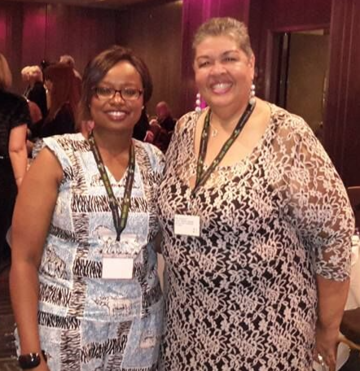
Ann Mbaabu, left, with the High Commissioner in London for Jamaica, Alound Ndombet-Assamba at ceremony in London.
Mbaabu eventually did marry outside her community to a man she met while working in a bank, joining Stima SACCO Society in 2012, leading a branch that serves a number of “marginalized” communities. The job change was no accident. “The decision to join Stima SACCO was very timely as I had made a conscious decision to make a difference in the lives of the community around me, an opportunity I could not get during my career as a banker,” said Mbaabu, adding that she has taken certain lessons learned at the bank and then sought to put a CU stamp on them: “My mantra is ‘Stima SACCO thinks like a bank, acts as a SACCO.’”
She has indeed made a difference(s). Consider:
- In a country in which what we in the U.S. would politely call “sexism” is prevalent, and which Mbaabu summed up with the adage “the woman’s place is in the kitchen,” it probably comes as no surprise most Kenyan women are, to again be polite, “financially marginalized.” That has led many women to participate in what are called “chamas,” groups of women who come together to contribute small amounts of money toward a common fund. Sound familiar? Mbaabu said the practice is more informally known as “table banking,” and she has been working to go from the table to the national marketplace by taking “these groups to the next level through the expertise and best practices to be learnt from the women empowerment program. I’m a firm believer of empowering a woman is empowering a nation.”
- Mbaabu, who is not Muslim, has developed a close friendship with a woman who is, and both are passionate about empowering women. That friend, like most in her community, is in an arranged marriage, but unlike most women in that same community has an education and a professional career.
“Education in the Muslim community is considered a preserve of the male child,” said Mbaabu. “This leads to the woman becoming totally dependent on the husband and, in the event of a divorce, this renders the woman homeless without a source of income and with inadequate education to enable her get a good job, which forces her to engage in desperate actions to be able to provide for her family.”
Forums For Women
That scenario has led Mbaabu and her friend to create the Amira Group, which keeps in constant communication using the WhatsApp phone application. “Amira” stands for queen in Islam. Mbaabu said she has come to learn some of the basic concepts of Islamic banking.
“We have held a number of forums where the women are now members of our credit union and are saving up, and their families are now improving, although I constantly face the challenge of not having a Sharia-compliant product offering within the SACCO, as a majority of the women are Muslims,” she said. “To counter this, I put a proposal across to our CEO and was mandated to work with other stakeholders and be in charge of a product development team to help develop a Sharia compliant product for our credit union.”
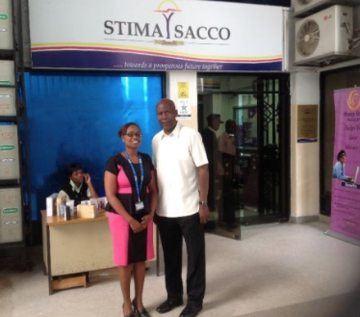
Ann Mbaabu at Stima SAACO in Kenya.
Mbaabu said the CU’s program has helped to build self-esteem among the women, who often lack even the confidence to communicate to others.
- Mbaabu said she has also helped to organize 73 other “chammas,” 50 of which are women’s groups, with which the credit union now has relationships.
Earlier this year, as the result of all the work Mbaabu has done, she was a member of the Young African Leadership Initiative, she got to meet with President Obama when he visited Kenya, and she has also spearheaded the Stima SACCO Women Network Forum. Next up: taking those lessons learned and the concepts incubated inside her own credit union to work with KUSCCO- Kenya Union of Savings and Credit Corporative Society– for wider reach to all cooperatives in Kenya.
Help For Aboriginal Peoples of the Outback
The second lesson in being humble this holiday season comes from the other side of the planet, Traditional Credit Union in Australia. That’s where Debbie Say has had more than a say in the lives of people in the Australian outback and rural communities.
To truly understand the plight of credit union members is to truly understand that issues affecting those members go far deeper than savings and loan balances. Ms. Say’s work in one of the most remote regions of the earth has ensured that members cannot only continue to save and continue to pay on loans, they can enjoy far higher qualities of life. Her work in addressing diabetes with indigenous populations largely unaware of their risks has helped to silence a silent killer
Say, who has diabetes, began her work with a modest goal. “My aim was that if I helped one person to understand what being a diabetic was like and how to manage it, my job was done.”
Say has helped far more than one person, but she says her job is also far from done.

As its name implies, Traditional Credit Union serves traditional populations. Its logo represents the strings of the Australian “dilly bag,” or moneybag, the place were traditionally a person’s most valuable possessions are kept. The logo’s colors are the same as the Aboriginal flag. The credit union was created after the major banks withdrew from remote communities.
Say began her work at the CU as a temp, which is funny, since the results of her work are so permanent. That was 15 years ago and she’s now a Remote Training Officer, meaning she spends three out of every four weeks traveling among its 17 branches in a part of the world where traffic is seldom an aggravation.
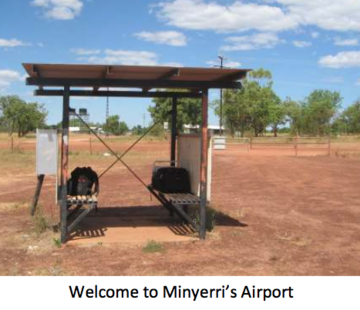
In 2009, Say, who had already been working on diabetes education with the CU’s staff, wrote a cook book with recipes that used ingredients that could be traditionally hunted and gathered or were readily available at the local store at the credit union’s Minyerri branch, which is about 570 kilometers southeast of Darwin (note: that’s not close to anything).
Minyeri, incidentally, is not exactly the kind of SMSA to which a U.S. credit union would race to hang a shingle. The town’s entire population is about 450 people, and when Traditional CU opened it had just 10% of them as members. Today, it’s about 95%.
After one branch employee missed work because she had forgotten to take her diabetes medicine, Say said she began making “tasty, diabetic friendly snacks for the staff and their families.”
“By being able to get the message to our staff about a better diet and understanding of managing their condition means that we have a lot less sick days being taken and the branches can operate with a full cash service,” says Say. “I have checked with the HR department and there has been a drop of about 60% of those staff who stated that they were diabetic.”
Beyond Just Diabetes Education
Say’s work has now expanded beyond just diabetes education. She has met with women’s and men’s groups to boost awareness of the CU, reached into schools to help build financial literacy—and trained staff to teach literacy, and helped to ensure that when members say they are saving for a specific purpose, that is where the funds go.
I’m happy to announce that both Ms. Mbaabu and Ms. Say were named as winners of first place awards for their work during a recent ceremony in London. And I should add they were hardly alone: other Development Educators (DEs) honored included Jose Allen S. Bartalo of the Bugasong Multi-Purpose Cooperative in the Philippines. All he did was organize programs to feed elderly citizens, help champion watershed conservation, and organize typhoon relief.
So, what do you have planned for the holidays?
Frank J. Diekmann is Cooperator in Chief at CUToday.info and can be reached at Frank@CUToday.info. He can also be found on Twitter at @FrankCUToday