

By Brad Kime
The successful initial public offerings of Lending Club and OnDeck continue to reinforce the adoption, scale and economic viability of online lending platforms. Data from pre-IPO S1 filings show just how fast these companies are growing:

- Lending Club’s loan originations increased from $717.9 million in 2012 to $2.1 billion in 2013, an increase of 188%. In total Lending Club has made more than $5 billion in loans.
- OnDeck’s loan originations have increased at a compound annual growth rate of 127% from 2011 to 2013, with a year-over-year growth rate of 171% for the nine months ending September 30, 2014. In total OnDeck has made more than $1.7 billion in loans.
Online lending platforms are growing rapidly, outpacing many financial institutions in the process, and capturing a new generation of borrowers. We predict that over the next decade online loans will account for one-third of the consumer lending market, which currently stands at $3.2 trillion (excluding mortgages).
Credit unions can either sit idly by and allow new entrants to take away significant borrowing capital, or they can use their unique histories, rich data and community focus to succeed in online lending. We believe that credit unions have a lot to gain in the upcoming shift in consumer lending, but they must first understand the drivers for this shift, and adapt accordingly.
From Experiences to Expectations
Today, consumers can use online marketplaces to purchase almost anything from anywhere, at their convenience. In contrast, most loan products are still purchased at brick-and-mortar branches, during normal business hours. Credit unions that don't facilitate easy-to-use online services may find themselves at a strong disadvantage to competitors who cater to shifting consumer preferences.
Today's consumers are drawn to speed and convenience, something easily available through online lending. That's why we believe that online lending is specifically positioned to capture the attention and capital of the new generation of borrowers. Millennials, a generation accustomed to access at a moment’s notice, will become a third of the borrowing population by 2025.
The Millennial borrowing population is already starting to get a taste for online lending platforms, witnessing first-hand how lending decisions can be made instantly and funds dispersed quickly. Today, a borrower looking for a loan from a credit union needs to apply at a branch, and may wait a couple of days before receiving a decision about their application. The same can find an online lender, apply for a loan, receive a decision within minutes, and receive their funds in a couple of days.
How long before these new consumer experiences turn into consumer expectations? It takes less time for a consumer to go through the entire application and approval process online than it does to simply get notice of receipt of application from a bank. All things being equal, credit unions that help their members save time while achieving their goals will attract a larger portion of Millennial interest and capital.
Moving Beyond FICO
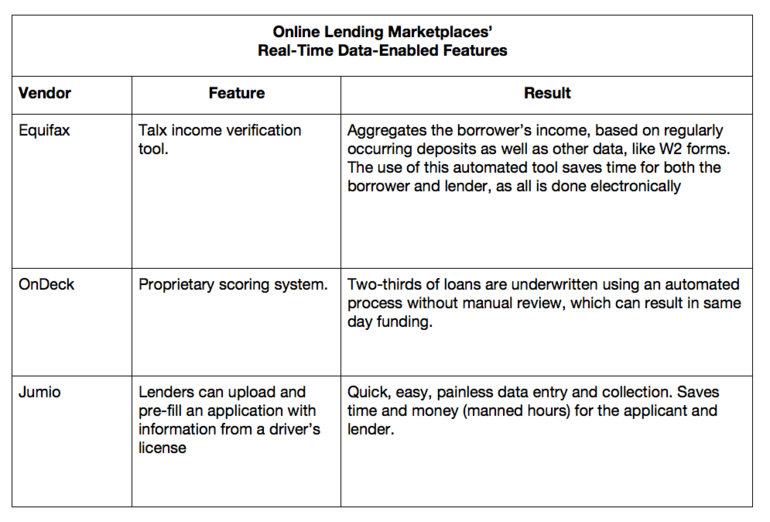
Credit unions have a wealth of data on their members—income, social security numbers, assets, and debts—more so than many other retailers. But online marketplaces are able to leverage the real-time, data-centric nature of their platforms in ways that brick-and-mortar credit unions are not today. Online lending marketplaces can use real-time data to allow borrowers to better manage their cash flow, eliminate manual review, automatically match loans with applicants based on borrower profiles, or approve same-day funding.
New lenders are mining thousands of online and offline data points, and building risk models that incorporate FICO scores, academic performance, online behavior, social media connections, and much more. Not only are they innovating the way they use technology to analyze traditional scoring data, but also in which data points they search for and consider when they approve or reject loan applicants.
Online lending can automatically arm credit unions with new data sources, and with the right internal infrastructure or external lending partner, credit unions can use that data to significantly grow their portfolio and lend to consumers they previously may not have considered.
Next Generation Lending
Credit unions are uniquely positioned to take advantage of the shift towards online lending. They have incredible amounts of rich information on their members and often offer lower rates than other institutions. But the traditional credit union is still not positioned to efficiently scale its lending and marketing activity in the same way modern online marketplaces can.
Credit unions do have options for entering online lending, of course. One option is for a credit union to build out internal systems and infrastructure to enter online lending. This is usually a very time consuming and costly endeavor. In our 8 years of experience at LendKey, we've found that most credit unions do not have the resources or the time to invest in such large operations.
Another option is for credit unions to use an external white-label platform to offer loans directly to consumers. This option allows credit unions to quickly enter online lending, connect with a new population of borrowers, maintain their brand's direct connection to consumers, and avoid the infrastructure costs.
Online lending is an inevitable disruptor and change agent in the credit landscape. Credit unions have the opportunity to use online marketplace platforms to ride the digital shift and grow their lending base. With competitive loans and a member focus, credit unions that make their products available online stand to gain a large portion of Millennial borrowing.
Brad Kime is chief revenue officer with Lendkey Technologies, New York. Mr. Kime can be reached at brad.kime@lendkey.com