

By Frank J. Diekmann
Here are two words that may stop you cold from reading any further: presidential election.

Those words seem to engender the same reaction as introducing yourself at a party as an IRS auditor: prepare to spend (another) night alone with the chips and dip.
If you’re still with me, trust me, I’ve heard your Pavlovian response: you’re sick of the presidential election, which seems to have been running since President Obama finished saying “So help me God” at the 2013 swearing in. Already there’s talk of the 2020 race (!), and it seems impossible to find a place—any place, the bottom of the sea, dark side of the moon, inside the mind of a texting ‘tween—where you can find some solitude away from the around-the-clock saturation coverage of the presidential races.
And yet apparently some people have—and there is a lesson here for credit unions.
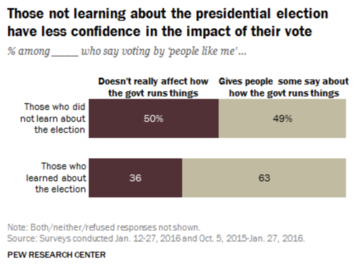
According to research released by the Pew Trusts, about one-in-ten Americans (9%) said they did not learn about this year’s presidential election in a given week from any of 11 types of sources asked about in a January Pew Research Center survey. The reason, Pew said, seems to be the “one striking trait” the group shares: a lack of faith in the impact of voting.
Source: Pew Trusts
Half of this group thinks that their vote doesn’t really affect how the government runs things, Pew reported, noting that these same people also show other signs of being less engaged in government affairs: only 37% of them follow government and public affairs at least some of the time, compared with 82% of Americans who got news and information about the election.
Pew also found that American adults ages 18 to 29 are more likely than any other age group to have not learned about the election.
While you may find yourself a bit jealous of this disengaged yet blissful 10%, there is an insight to be gleaned here for credit unions, which have always been quick to point out they are “democratically” run financial co-ops. Like many elections, especially local races, “turn-out” is frequently low for credit union board “races,” which are often about as much a race as Fidel Castro’s re-election campaign. Some will argue that high satisfaction is the reason for low membership participation in board elections, but that’s usually the argument from board members attempting to justify why so little effort was made by the board to encourage anyone to run.
As a country, we all lose when people become disengaged from the democracy; it only seems to embolden the nutcases from the fringe on both sides to get engaged, which in turn turns more people off, which in turn, well…
Some (maybe a lot) of board members may like the slam dunk reelections, but credit unions lose, too, when members are disengaged. Members who understand they are members, who understand they get to vote, who understand how that makes the credit union different, are engaged members—and engaged members are profitable members.
There is an old political observation that people vote with their wallets—in the case of credit unions, the inverse is true, too—members will bring more of their wallet when they know their vote counts for something. So tell them. And tell them again—before they elect to go elsewhere.
Speaking of Democracy
Speaking of democracy, as CUToday.info was first to report, CUNA-affiliated credit unions voted in favor of the so-called “choice” issue, an issue that was driven in large part by the perception the CUNA board didn’t listen to the CUNA/league voters who told a task force they wanted options on belonging to a league, the national trade association, or both.
In a much larger context, the issue is about more than how dues dollars are spent: it’s about the value of participating in the greater whole. Many large—especially federal charters—don’t feel they need their state associations any longer, so the question comes down to whether they see the bigger, more cooperative picture that includes those smaller credit unions that do need their leagues and the joint resources they deliver. We’ll soon see.
The question isn’t limited to the United States. In Ireland, St. Raphael’s Garda Credit Union has disaffiliated from the Irish League of Credit Unions. The credit union, Ireland’s largest, issued a statement saying it was financially secure and had no need for the deposit insurance program the league provides, nor does it need any other support from the ILCU.
There are a lot of divided politics in Ireland’s credit unions, and even an alternative national association, so more could be at play than a large CU outgrowing the shared resource that helped it to grow to where it is today. But the issue again becomes whether a credit union sees the entire landscape, including whether its vote counts for something larger than itself.
What Language is This?
From the Try To Figure It Out Dept., a Canadian credit union was actually involved in something that was reported in local media under this headline: “Norquay rink wins Benito mixed bonspiel.” Curious as to what that might be? Go here.
Frank J. Diekmann is Cooperator in Chief at CUToday.info, and can be reached at Frank@CUToday.info and followed @FrankCUToday.