

By Frank J. Diekmann

Forget seeing them, we’re living them–the daily reports and photos and videos of streets that are empty and food bank lines that are full, of morgues with no vacancy signs and skies without contrails, of pipelines (both oil and loan apps) that aren’t flowing and tears that are.
For those reasons and so many others, it seems difficult to believe during this unimaginable coronavirus pandemic there are plenty of people who are worried too many leaders at credit unions, and especially their regulators, aren’t taking seriously enough what’s going on right now and, critically, what lies ahead for the rest of the year and 2021.
And yet that’s the sense I often get, as well. I’m hope I’m wrong, but…
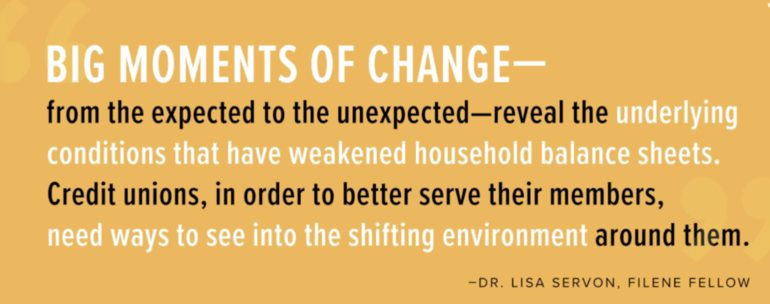
During a webinar (coverage here) hosted by the Filene Research Institute last week Dr. Lisa Servon, who is heading up Filene’s new Center on Lives in Transition, offered the observation you see below: “Big moments of change—from the expected to the unexpected—reveal the underlying conditions that have weakened household balance sheets.”
When I heard that observation the first thought I had was you can substitute the words “credit union” for “household,” as the economic crater is turning out to be far deeper than any had imagined, and it could very likely mean a significant shakeout in the number of credit unions when that “normal” everyone is waiting for ever returns.
The Swoosh Recovery
In March, the big economic debate was over whether we will see a “U” or “V” shape recovery. Neither appears likely now, and the most intriguing forecast I have heard has come from CUNA Mutual’s chief economist, Steve Rick, who said the recovery is going to be Nike-swoosh shaped, meaning a fast and deep decline followed by a slow upward trendline (I feel fairly confident Nike is not going to be encouraging that metaphor).
As CUToday.info reported here, Rick is offering a pretty sobering forecast for credit unions for the latter half of 2020 and 2021—going as far as to project credit unions’ average ROA in 2021 will be negative. One wonders how many CUs are really preparing for that.

Rick is hardly alone in trying to warn credit unions an iceberg lies ahead. During a town hall hosted by the Maryland/DC Credit Union Association, Maryland’s chief economist, Andy Schaufele, while acknowledging how difficult it is to make predictions with any certainty as the pandemic rages, said CUs might need to prepare for deflation in the near-term and high inflation and high interest rates in the long-term.
The Lens of the Past
During that same town hall, NCUA Regional Director for the Eastern Region John Kutchey said the agency has been spending a lot of time modeling credit risk.
Many credit unions are doing the same. The challenge, of course, and it’s a frequent tripwire in planning, is the look forward is usually through the lens of the past. Modeling the unimaginable is by its definition impossible. And, by the way, you officially win the CU Award for Scenario Planning if during your management or board retreat in 2019 your organization included a bullet point for potentially using your closed lobby to sew, assemble and disinfect medical masks.
The future isn’t all dark, just a bit dusky right now and the sunrise seems a long night away. Still, credit unions have, after all, lived to see the sun rise after a Depression and a world war and inflation and stagflation and the Y2K bug and the collapse of the mortgage market and more to get to a new dawn each time. They survived all that by leveraging their cooperative nature and will need to do so again.
What we do know is the future is going to be different, as these four CEOs illustrated all too well.
The Tough Stuff
But before we get to that longer-term future, credit union leaders are going to need to deal with some tough short-term stuff, such as extraordinary balance sheet strains, potentially furloughing workers, and for even eventually saying “no” to some members who want to defer their deferments.
CUToday.info will continue to provide coverage of everything facing credit unions and how they are responding. We welcome your input at all times.
Frank J. Diekmann is Cooperator in Chief at CUToday.info and can be reached at Frank@CUToday.info or @FrankCUToday.info.