MADISON, Wis.–As CUToday.info reported on Friday, the System Structure and Governance Task Force made three primary recommendations to the CUNA board, with the board opting to OK only the recommendation related to advocacy.
But delve deeper into the 24-page task force report and there are numerous other details about the breadth of the task force’s research and review. The report makes clear the task force on where credit unions are headed, citing forecasts for credit union consolidation and for changes in the asset classes within credit unions. It projects 4,954 total CUs by 2024, for instance (scroll down for chart).
The task force detailed the research it conducted before arriving at its recommendations, including retaining an independent research firm to conduct focus. Three pairs of focus groups were conducted in the winter of 2014/2015 in Connecticut, Illinois and California. The task force said that at each site, a group of smaller credit unions (mostly under $50 million in assets) and larger credit unions (mostly with assets between $100 million and $500 million) met. Very large credit unions — with over $1 billion in assets — had met previously on the same topic at a national meeting in October, 2014, the task force said.
“There were some differences in views expressed at the focus groups across the three sites, but the more significant differentiator was credit union size,” the task force reported.
Not surprisingly, the task force said it found the smallest credit unions (defined as those up to $100 million assets), primarily desired operational support in the form of practical resources from their trade association, with their primary contacts via with their respective state leagues. Smaller CUs “value and appreciate leagues more than CUNA due to this greater familiarity…They wish CUNA and Leagues would do more for them, such as fostering collaboration, to help them to compete. These credit unions believe large credit unions are self-sufficient, and do not need the same type of support that small credit unions do.”
Larger CUs, those up to $1 billion in assets, have a “greater appreciation for what CUNA does,” the task force said the focus groups found. “But also have more concerns that CUNA is not accomplishing major legislative goals (e.g. MBL cap, supplemental capital).”
The top priority of the larger CUs is political representation and proactive NCUA advocacy, the task force found. The same group of CUs values educational products of both leagues and CUNA, and sees room for further improvement.
Those credit unions also expressed a desire for “CUNA and NAFCU to either better unify their efforts or merge.”
The larger CUs also expressed concern about “the future of small credit unions, and what further consolidation might mean for the image and advocacy efforts of the credit union industry.
According to the task force, CUs of more than $1 billion want a “powerful, lean and aggressive national trade association, closely aligned with streamlined, efficient state or regional associations. Most believe that credit unions should be free to choose which components of the system they affiliate with. Joint membership should not be required, but instead should be encouraged by accountability, performance and pricing incentives.”
The largest CUs also believe CUNA’s primary role should be legislative and regulatory advocacy.
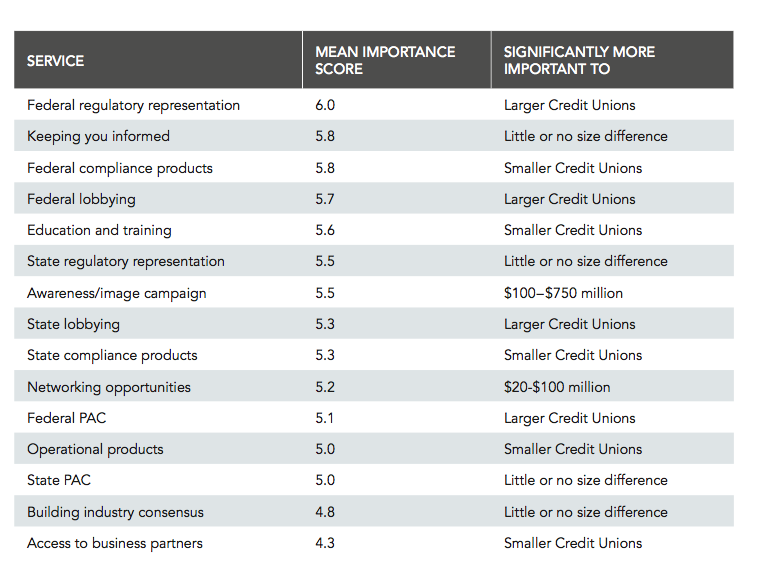
What’s important to CUs in each asset size group can be seen in the chart.
Among other findings by the task force:
- There is general support for the current structure of CUNA dues, and for leagues to continue to individually establish their own dues formulas. However, this does not necessarily imply satisfaction with the levelof dues. Neither CUNA nor the leagues are rated very highly for “value for dues paid,” especially by larger credit unions, the task force said.
- A plurality of credit unions (42%) favor the option of choosing CUNA and/or league membership separately; 36% favor the current system in which joint CUNA and league membership is required. Thirteen percent support a system of national membership that would include both CUNA membership and access to all leagues.
- The vast majority (80%) of all credit unions prefer to maintain the current system of one vote per credit union for matters put before the membership. However, a slight majority (52%) of large credit unions would prefer that votes be weighted by asset size or dues paid.
- Just over half of credit unions (54%) believe the current CUNA board size of 24 is about right. The remaining opinions are about evenly split between expressing the board is too large and having no opinion. Almost no one feels the board is too small. However, there are sharp differences by credit union size.